
|
You entered: galaxies
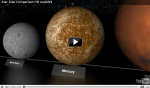 Star Size Comparisons
22.02.2011
How big is our Sun compared to other stars? In a dramatic and popular video featured on YouTube, the relative sizes of planets and stars are shown from smallest to largest. The above video starts with Earth's Moon and progresses through increasingly larger planets in our Solar System.
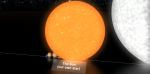 Star Size Comparisons
6.06.2013
How big is our Sun compared to other stars? In a dramatic and popular video featured on YouTube, the relative sizes of planets and stars are shown from smallest to largest. The above video starts with Earth's Moon and progresses through increasingly larger planets in our Solar System.
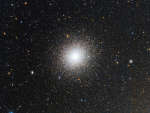 Globular Star Cluster 47 Tuc
24.10.2020
Globular star cluster 47 Tucanae is a jewel of the southern sky. Also known as NGC 104, it roams the halo of our Milky Way Galaxy along with some 200 other globular star clusters.
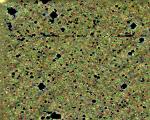 The Cosmic Infrared Background
6.02.2002
What cosmic wallpaper is on the sky? The answer depends on the type of light considered, and for some wavelengths, all the cluttering material in the foreground makes it still unknown. Recently, however...
 A Quasar Portrait Gallery
9.03.2002
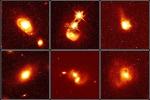
Quasars (QUASi-stellAR objects) lie near the edge of the observable Universe. Discovered in 1963, astronomers were astounded that such objects could be visible across billions of light-years, as this implies they must emit prodigious amounts of energy. Where does the energy come from?
 A Star Forming Region in the LMC
23.08.1997
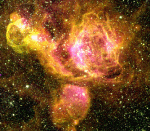
Stars sometimes form in colorful ways. Pictured above is a small region in the nearby LMC galaxy where stars are forming. After a star is born, it may do several things to energize its immediate neighborhood.
 Stars of the Galactic Center
13.01.2006
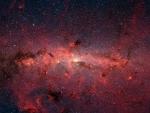
The center of our Milky Way Galaxy is hidden from the prying eyes of optical telescopes by clouds of obscuring dust and gas. But in this stunning vista, the Spitzer Space Telescope's infrared cameras, penetrate much of the dust revealing the stars of the crowded galactic center region.
 Stars of the Galactic Center
10.02.2007
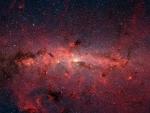
The center of our Milky Way Galaxy is hidden from the prying eyes of optical telescopes by clouds of obscuring dust and gas. But in this stunning vista, the Spitzer Space Telescope's infrared cameras, penetrate much of the dust revealing the stars of the crowded galactic center region.
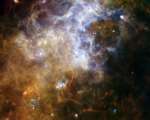 Herschel Views the Milky Way
2.09.2011
With a 3.5 meter diameter mirror, larger than the Hubble Space Telescope, ESA's Herschel Space Observatory explores the Universe at infrared wavelengths. Herschel is named for German-born British astronomer Frederick William Herschel who discovered infrared light over 200 years ago.
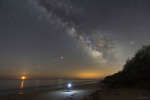 Moon, Mars, Saturn, Jupiter, Milk Way
20.05.2020
It is not a coincidence that planets line up. That's because all of the planets orbit the Sun in (nearly) a single sheet called the plane of the ecliptic. When viewed from inside that plane -- as Earth dwellers are likely to do -- the planets all appear confined to a single band.
|
January February March April May |
|||||||||||||||||||||||||||||||||||||||||||||||||