
|
You entered: galaxies
 Contemplating the Sky
8.08.2004
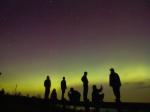
Have you contemplated your sky recently? This week will be a good one for midnight meditators at many northerly locations as meteors from the Perseid meteor shower will frequently streaked through. The Perseid meteor shower has slowly been building to a crescendo and should peak on the nights of August 11 and 12.
 The Millennium that Defines Universe
31.12.1999
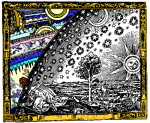
Welcome to the millennial year at the threshold of millennium three. During millennium two, humanity continually redefined its concept of "Universe": first as spheres centered on the Earth, in mid-millennium as the Solar System, a few centuries ago as the Galaxy, and within the last century as the matter emanating from the Big Bang.
 Too Close to a Black Hole
6.12.2010
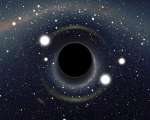
What would you see if you went right up to a black hole? Above is a computer generated image highlighting how strange things would look. The black hole has such strong gravity that light is noticeably bent towards it - causing some very unusual visual distortions.
 The Little Dipper
14.05.2011
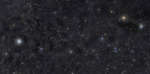
At 2nd magnitude, Polaris is far from the brightest star in the night sky. But it is the brightest star at the left of this well-composed, starry mosaic spanning about 23 degrees across the northern sky asterism dubbed the Little Dipper.
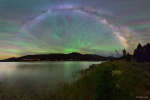 An Airglow Fan from Lake to Sky
26.01.2016
Why would the sky look like a giant fan? Airglow. The featured intermittent green glow appeared to rise from a lake through the arch of our Milky Way Galaxy, as captured last summer next to Bryce Canyon in Utah, USA.
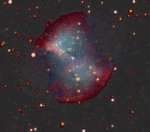 M27: The Dumbbell Nebula
29.07.1995
The Dumbbell Nebula is a beautiful red and blue planetary nebula in the constellation of Vulpecula. It is the 27th object on Charles Messier's list of diffuse sky objects, and so is referred to as M27. Its high surface brightness makes it a good target for small telescopes.
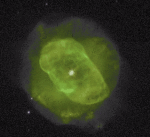 NGC 5882: A Small Planetary Nebula
28.08.1996
Will most stars one day look like this? Pictured above is the planetary nebula NGC 5882, captured by the Hubble Space Telescope. Although planetary nebulae can appear similar to planets like Uranus and Neptune, they are actually gas clouds surrounding stars typically hundreds of light years away.
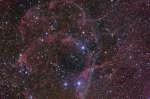 Vela Supernova Remnant
31.12.2014
The plane of our Milky Way Galaxy runs through this complex and beautiful skyscape. At the northwestern edge of the constellation Vela (the Sails) the telescopic frame is over 10 degrees wide, centered on the brightest glowing filaments of the Vela Supernova Remnant, an expanding debris cloud from the death explosion of a massive star.
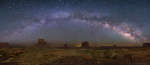 The Milky Way Over Monument Valley
31.10.2015
You don't have to be at Monument Valley to see the Milky Way arch across the sky like this -- but it helps. Only at Monument Valley USA would you see a picturesque foreground that includes these iconic rock peaks called buttes.
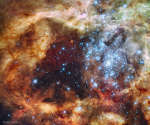 Star Cluster R136 Bursts Out
23.01.2016
In the center of star-forming region 30 Doradus lies a huge cluster containing some of the largest, hottest, and most massive stars known. These stars, known collectively as star cluster R136, were captured in the featured image in visible light by the Wide Field Camera 3 in 2009 peering through the Hubble Space Telescope.
|
January February March April May |
|||||||||||||||||||||||||||||||||||||||||||||||||