
|
You entered: nearby
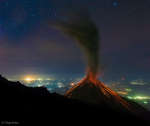 Volcano of Fire Erupts Under the Stars
10.03.2015
First, there was an unusual smell. Then there was a loud bang. But what appeared to the eye was the most amazing of all. While waiting near midnight to see a possible eruption of VolcАn de Fuego (Volcano of Fire) in Guatemala last month, a ready camera captured this extraordinary image.
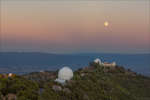 Solstice Dawn and Full Moonset
23.06.2016
A Full Moon sets as the Solstice Sun rises in this June 20 dawn skyscape. Captured from a nearby peak in central California, planet Earth, the scene looks across the summit of Mount Hamilton and Lick Observatory domes on a calendar date that marks an astronomical change of seasons and hemispherical extremes of daylight hours.
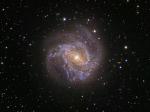 Spiral Galaxy M83: The Southern Pinwheel
24.07.2007
M83 is one of the closest and brightest spiral galaxies on the sky. Visible with binoculars in the constellation of Hydra, majestic spiral arms have prompted its nickname as the Southern Pinwheel. Although discovered...
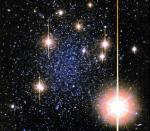 Pegasus dSph: Little Galaxy of the Local Group
22.01.1999
The Pegasus dwarf spheroidal galaxy (Peg dSph) is a small, newly recognized member of the Local Group of Galaxies. Likely a satellite companion of the Local Group's dominant player, the large spiral Andromeda (M31), the Pegasus dwarf galaxy is almost hidden in the glare of relatively bright foreground stars in our own Milkyway.
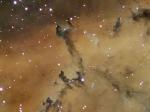 Dust Sculptures in the Rosette Nebula
10.01.2005
What creates the cosmic dust sculptures in the Rosette Nebula? Noted for the common beauty of its overall shape, parts of the Rosette Nebula, also known as NGC 2244, show beauty even when viewed up close.
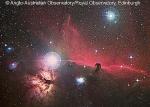 Orion's Horsehead Nebula
27.08.2000
The Horsehead Nebula is one of the most famous nebulae on the sky. It is visible as the black indentation to the red emission nebula seen just to the right of center of the above photograph. The bright star near the center is located in the belt of the familiar constellation of Orion.
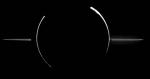 Jupiters Rings Revealed
9.01.2005
Why does Jupiter have rings? Jupiter's rings were discovered in 1979 by the passing Voyager 1 spacecraft, but their origin was a mystery. Data from the Galileo spacecraft that orbited Jupiter from 1995 to 2003 later confirmed that these rings were created by meteoroid impacts on small nearby moons.
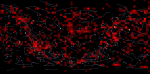 APOD Heatmap
16.06.2014
The first APOD appeared 19 years ago today. To help celebrate, APOD brings you today an all-sky heatmap of (nearly) 19 years of APOD entries. The brighter a region appears on the above heatmap, the more APODs that occur in that region.
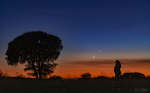 Venus and Jupiter on the Horizon
26.11.2019
What are those two bright objects on the horizon? Venus and Jupiter. The two brightest planets in the night sky passed very close together -- angularly -- just two days ago. In real space, they were...
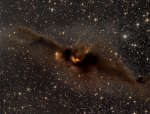 LDN 43: The Cosmic Bat Nebula
31.10.2022
What is the most spook-tacular nebula in the galaxy? One contender is LDN 43, which bears an astonishing resemblance to a vast cosmic bat flying amongst the stars on a dark Halloween night. Located...
|
January February |
|||||||||||||||||||||||||||||||||||||||||||||||||