
|
You entered: nearby
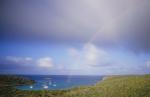 Moonbow with Sailboats
4.07.2001
Have you ever seen a moonbow? Just as rainbows are lit by the Sun, moonbows are lit by the Moon. Since the Sun is so much brighter than the Moon, sunlit rainbows are much brighter and more commonly seen than moonbows. Pictured above is a moonbow stretching over Salt Pond Bay in St.
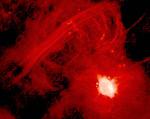 The Galactic Center Radio Arc
21.05.2002
What causes this unusual structure near the center of our Galaxy? The long parallel rays slanting across the top of the above radio image are known collectively as the Galactic Center Radio Arc and jut straight out from the Galactic plane.
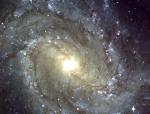 M83: The Southern Pinwheel Galaxy from VLT
11.05.2003
M83 is one of the closest and brightest spiral galaxies on the sky. Visible with binoculars in the constellation of Hydra, majestic spiral arms have prompted its nickname as the Southern Pinwheel. Although discovered...
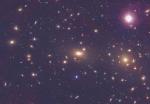 The Coma Cluster of Galaxies
28.03.1999
Almost every object in the above photograph is a galaxy. The Coma Cluster of Galaxies pictured is one of the densest clusters known - it contains thousands of galaxies. Each of these galaxies house billions of stars - just as our own Milky Way Galaxy does.
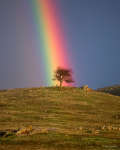 APOD: 2023 March 13 Б Rainbow Tree
13.03.2023
What lies at the end of a rainbow? Something different for everyone. For the photographer taking this picture, for example, one end of the rainbow ended at a tree. Others nearby, though, would likely see the rainbow end somewhere else. The reason is because a rainbow's position depends on the observer.
 An Apollo 12 Panorama
2.01.2004
The Apollo 12 mission was the second ever to land humans on the Moon. The mission was dedicated to studying the Moon, developing techniques, and developing instruments that could be used in future lunar landings.
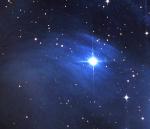 Reflection Nebula NGC 1435
1.03.1999
Reflection nebulae reflect light from a nearby star. Many small carbon grains in the nebula reflect the light. The blue color typical of reflection nebula is caused by blue light being more efficiently scattered by the carbon dust than red light.
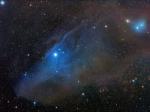 Horse Head Shaped Reflection Nebula IC 4592
8.08.2006
Do you see the horse's head? What you are seeing is not the famous Horsehead nebula toward Orion but rather a fainter nebula that only takes on a familiar form with deeper imaging. The main part of the above imaged molecular cloud complex is a reflection nebula cataloged as IC 4592.
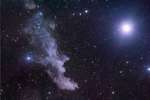 A Witch by Starlight
31.10.2008
By starlight this eerie visage shines in the dark, a crooked profile evoking its popular name, the Witch Head Nebula. In fact, this entrancing telescopic portrait gives the impression the witch has fixed her gaze on Orion's bright supergiant star Rigel.
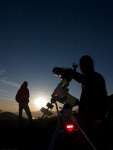 Star Party on Planet Earth
4.04.2009
As twilight sweeps around planet Earth tonight (April 4), many amateur astronomers will set up their telescopes for a 24-hour global star party. The planetwide star party is part of 100 Hours of Astronomy (100HA), a project of the International Year of Astronomy 2009.
|
January February March April May June July August September |
|||||||||||||||||||||||||||||||||||||||||||||||||