
|
You entered: Sun
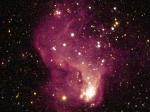 Star Forming Region Hubble V
25.12.2001
How did stars form in the early universe? Astronomers are gaining insight by studying NGC 6822, a nearby galaxy classified as irregular by modern standards but appearing more typical of galaxies billions of years ago. Inspection of NGC 6822 shows several bright star groups, including two dubbed Hubble-X and Hubble-V.
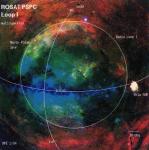 Loop I in the Northern Sky
3.05.1999
One of the largest coherent structures on the sky is known simply as Loop I and can best be seen in radio and X-ray maps. Spanning over 100 degrees, part of Loop I appears so prominent in northern sky maps that it is known as the North Polar Spur (NPS).
 The Galactic Center in Infrared
21.06.1999
The center of our Galaxy is a busy place. In visible light, much of the Galactic Center is obscured by opaque dust. In infrared light, however, dust glows more and obscures less, allowing nearly one million stars to be recorded in the above photograph.
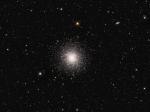 M13: The Great Globular Cluster in Hercules
18.05.2007
In 1714, Edmond Halley noted that M13 "shows itself to the naked eye when the sky is serene and the Moon absent." Of course, M13 is now modestly recognized as the Great Globular Cluster in Hercules, one of the brightest globular star clusters in the northern sky.
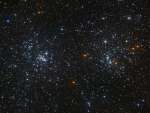 Double Cluster in Perseus
7.12.2007
Skygazers recently following Comet Holmes have probably also chanced across this lovely starfield, not far from the comet on the sky in the constellation Perseus. Some 7,000 light-years away, this pair of open or galactic star clusters is an easy binocular target and is visible to the unaided eye from dark sky areas.
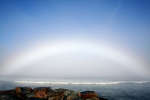 A Fog Bow Over Ocean Beach
29.05.2008
What is that white arch over the water? What is being seen is a fogbow, a reflection of sunlight by water drops similar to a rainbow but without the colors. The fog itself is not confined to an arch -- the fog is mostly transparent but relatively uniform.
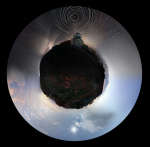 Night and Day above Almost Planet Sounio
17.01.2011
Has a new planet been discovered? What is pictured above is a remarkable 24 hour mosaic surrounding a spot on Sounio, Greece, right here on planet Earth. Images taken at night compose the top half of the picture, with star trails lasting as long as 11 hours visible.
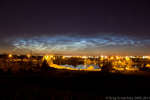 Noctilucent Clouds Over Edmonton
20.07.2011
Sometimes it's night on the ground but day in the air. As the Earth rotates to eclipse the Sun, sunset rises up from the ground. Therefore, at sunset on the ground, sunlight still shines on clouds above.
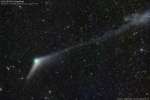 Comet Catalina Tails
1.01.2016
A new year's treat for binoculars, as 2016 begins Comet Catalina (C/2013 US10) now sweeps through planet Earth's predawn skies near bright Arcturus, alpha star of Bootes. But this telescopic mosaic from December 21 follows the pretty tails of the comet across a field of view as wide as 10 full moons.
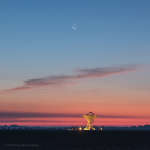 Moon, Mercury, and Twilight Radio
8.10.2016
Sharing dawn's twilight with the Moon on September 29, Mercury was about as far from the Sun as it can wander, the innermost planet close to its maximum elongation in planet Earth's skies.
|
January February |
|||||||||||||||||||||||||||||||||||||||||||||||||