
|
You entered: Sun
 The Medusa Nebula
22.11.2024
Braided and serpentine filaments of glowing gas suggest this nebula's popular name, The Medusa Nebula. Also known as Abell 21, this Medusa is an old planetary nebula some 1,500 light-years away in the constellation Gemini. Like its mythological namesake, the nebula is associated with a dramatic transformation.
 3I/ATLAS: A View from Planet Earth
21.11.2025
Now outbound after its perihelion or closest approach to the Sun on October 29, Comet 3I/ATLAS is only the third known interstellar object to pass through our fair Solar System. Its greenish coma...
 Aurora Crown the Earth
27.05.1996
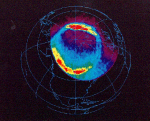
What do aurora look like from space? The POLAR spacecraft answered this by photographing an auroral oval surrounding the north pole of the Earth, causing displays on both the night and day side. The auroral sub-storm, pictured in false-color above, developed within 15 minutes and may have lasted as long as on hour.
 MyCn18: An Hourglass Nebula
15.06.2002
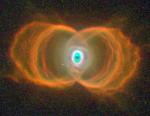
The sands of time are running out for the central star of this hourglass-shaped planetary nebula. With its nuclear fuel exhausted, this brief, spectacular, closing phase of a Sun-like star's life occurs as its outer layers are ejected - its core becoming a cooling, fading white dwarf.
 A Fleeting Eclipse
27.08.1997
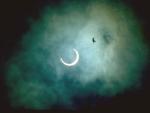
A lunar eclipse can be viewed in a leisurely fashion. Visible to anyone on the night side of planet Earth (weather permitting), totality often lasts an hour or so as the moon glides through the Earth's shadow. But a solar eclipse is more fleeting.
 Aurora Over Edmonton
4.11.2003
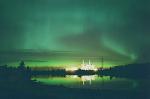
Northern and southern locales saw many a beautiful aurora over the last week, as particles from several large solar flares impacted the Earth. Many reported unusually red auroras, although colors across the spectrum were also seen. Power grids and orbiting satellites braced for the onslaught, but little lasting damage was reported.
 Saturn in the Hive
28.01.2006
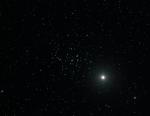
If you can find Saturn in tonight's sky, then you can also find M44, popularly known as the Beehive star cluster. In fact, with a pair of binoculars most casual skygazers should find it fairly easy to zero in on this celestial scene.
 Globular Star Cluster M3
9.06.2007
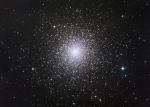
This immense ball of half a million stars older than the Sun lies over 30,000 light-years away. Cataloged as M3 (and NGC 5272), it is one of about 150 globular star clusters that roam the halo of our Milky Way Galaxy.
 Comet Holmes Grows a Tail
5.11.2007
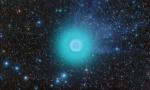
Comet Holmes continues to be an impressive sight to the unaided eye. The comet has diminished in brightness only slightly, and now clearly appears to have a larger angular extent than stars and planets. Astrophotographers have also noted a distinctly green appearance to the comet's coma over the past week.
 NGC 6888: The Crescent Nebula
11.11.2007
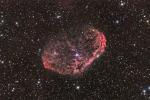
What caused the Crescent Nebula? Looking like an emerging space cocoon, the Crescent Nebula, visible in the center of the above image, was created by the brightest star in its center. A leading progenitor hypothesis has the Crescent Nebula beginning to form about 250,000 years ago.
|
January February |
|||||||||||||||||||||||||||||||||||||||||||||||||