
|
You entered: stars
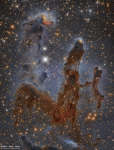 Pillars of the Eagle Nebula in Infrared
20.06.2018
Newborn stars are forming in the Eagle Nebula. Gravitationally contracting in pillars of dense gas and dust, the intense radiation of these newly-formed bright stars is causing surrounding material to boil away. This image...
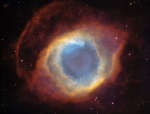 The Helix Nebula from Blanco and Hubble
23.08.2020
How did a star create the Helix nebula? The shapes of planetary nebula like the Helix are important because they likely hold clues to how stars like the Sun end their lives. Observations...
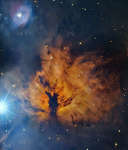 Alnitak and the Flame Nebula
12.04.2021
What lights up the Flame Nebula? Fifteen hundred light years away towards the constellation of Orion lies a nebula which, from its glow and dark dust lanes, appears, on the left, like a billowing fire. But fire, the rapid acquisition of oxygen, is not what makes this Flame glow.
 Rubin's Galaxy
18.09.2021
In this Hubble Space Telescope image the bright, spiky stars lie in the foreground toward the heroic northern constellation Perseus and well within our own Milky Way galaxy. In sharp focus beyond is UGC 2885, a giant spiral galaxy about 232 million light-years distant.
 Rubin s Galaxy
5.04.2023
In this Hubble Space Telescope image the bright, spiky stars lie in the foreground toward the heroic northern constellation Perseus and well within our own Milky Way galaxy. In sharp focus beyond is UGC 2885, a giant spiral galaxy about 232 million light-years distant.
 Pic du Pleiades
9.12.2023
Near dawn on November 19 the Pleiades stood in still dark skies over the French Pyrenees. But just before sunrise a serendipitous moment was captured in this single 3 second exposure; a bright meteor streak appeared to pierce the heart of the galactic star cluster.
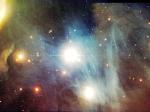 A Chamaeleon Sky
9.06.2002
A photogenic group of nebulae can be found toward Chamaeleon, a constellation visible predominantly in skies south of the Earth's equator. Celestial objects visible there include the blue reflection nebulas highlighted by thin dust surrounding the bright stars in the above image center.
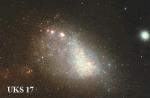 The Small Cloud of Magellan (SMC)
25.01.1998
Almost unknown to casual observers in the northern hemisphere, the southern sky contains two diffuse wonders known as the Magellanic Clouds. The Magellanic Clouds are small irregular galaxies orbiting our own larger Milky Way spiral galaxy.
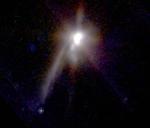 An Extrasolar Planet?
29.05.1998
This infrared Hubble Space Telescope view may contain the first ever direct image of a planet outside our own solar system. The picture shows a very young double star located about 450 light-years away toward the constellation of Taurus.
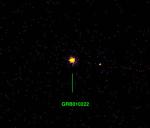 GRB010222: Gamma Ray Burst, X Ray Afterglow
13.04.2001
A fading afterglow from one of the most powerful explosions in the universe is centered in this false color image from the spacebased Chandra X-ray Observatory. The cosmic explosion, an enormously bright gamma-ray burst (GRB), originated in a galaxy billions of light-years away and was detected by the BeppoSAX satellite on February 22.
|
January February March April May June July August September |
|||||||||||||||||||||||||||||||||||||||||||||||||