
|
You entered: stars
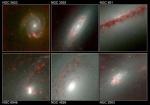 An Infrared Galaxy Gallery
22.03.1999
Where do stars form in galaxies? One way to find this out it to look for glowing hydrogen, a material common to hot star-forming regions. To find large areas of glowing hydrogen, the Hubble Space Telescope's NICMOS instrument surveyed about 100 nearby spiral galaxies.
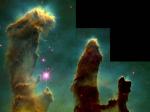 M16: Pillars of Creation
18.02.2007
It has become one of the most famous images of modern times. This image, taken with the Hubble Space Telescope in 1995, shows evaporating gaseous globules (EGGs) emerging from pillars of molecular hydrogen gas and dust.
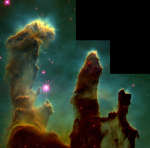 M16: Pillars of Creation
28.03.2010
It has become one of the most famous images of modern times. This image, taken with the Hubble Space Telescope in 1995, shows evaporating gaseous globules (EGGs) emerging from pillars of molecular hydrogen gas and dust.
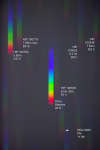 A Spectrum of Nova Delphini
23.08.2013
When a new star appeared in the constellation Delphinus late last week, astronomers found its spectrum hinted at the apparition's true nature. Now known as Nova Delphini, its visible light spectrum near maximum...
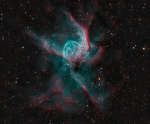 NGC 2359: Thor s Helmet
15.02.2014
This helmet-shaped cosmic cloud with wing-like appendages is popularly called Thor's Helmet. Heroically sized even for a Norse god, Thor's Helmet is about 30 light-years across. In fact, the helmet is more...
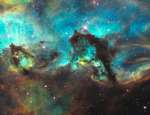 The Seahorse of the Large Magellanic Cloud
29.11.2014
It may look like a grazing seahorse, but the dark object toward the image right is actually a pillar of smoky dust about 20 light years long. The curiously-shaped dust structure occurs in our neighboring Large Magellanic Cloud, in a star forming region very near the expansive Tarantula Nebula.
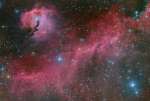 The Seagull Nebula
29.08.2015
A broad expanse of glowing gas and dust presents a bird-like visage to astronomers from planet Earth, suggesting its popular moniker - The Seagull Nebula. This portrait of the cosmic bird covers a 1.6 degree wide swath across the plane of the Milky Way, near the direction of Sirius, alpha star of the constellation Canis Major.
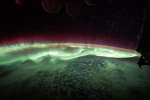 Aurora Slathers up the Sky
29.07.2017
Like salsa verde on your favorite burrito, a green aurora slathers up the sky in this June 25 snapshot from the International Space Station. About 400 kilometers (250 miles) above Earth, the orbiting station is itself within the upper realm of the auroral displays.
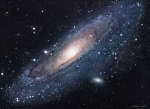 M31: The Andromeda Galaxy
17.12.2018
What is the nearest major galaxy to our own Milky Way Galaxy? Andromeda. In fact, our Galaxy is thought to look much like Andromeda. Together these two galaxies dominate the Local Group of galaxies. The diffuse light from Andromeda is caused by the hundreds of billions of stars that compose it.
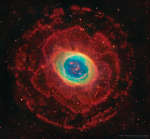 Rings Around the Ring Nebula
18.08.2021
The Ring Nebula (M57), is more complicated than it appears through a small telescope. The easily visible central ring is about one light-year across, but this remarkably deep exposure - a collaborative effort combining data from three different large telescopes - explores the looping filaments of glowing gas extending much farther from the nebula's central star.
|
January February March April May June July August September |
|||||||||||||||||||||||||||||||||||||||||||||||||