
|
You entered: stars
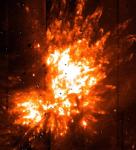 The Kleinmann Low Nebula
2.03.1999
The most active part of the Orion Nebular Cloud Complex is an area known as the Kleinmann-Low Nebula. There, a cluster of young and forming stars is embedded in a molecular cloud filled with dust.
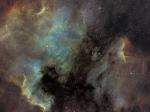 The North America and Pelican Nebulas
16.08.2006
Here are some familiar shapes in unfamiliar locations. This emission nebula on the left is famous partly because it resembles Earth's continent of North America. To the right of the North America Nebula, cataloged as NGC 7000, is a less luminous nebula that resembles a pelican dubbed the Pelican Nebula.
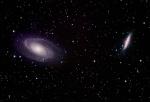 Galaxy Wars: M81 Versus M82
9.02.2000
In the left corner, wearing a red nucleus surrounded by blue spiral arms, is M81. In the right corner, sporting light stars and dark dust lanes, is M82. These two mammoth galaxies have been locked in gravitational combat for the past billion years.
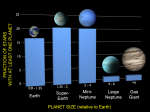 Ten Billion Earths
12.01.2013
How common are Earth-sized planets? Quite common, according to extrapolations from new data taken by NASA's orbiting Kepler spacecraft. Current computer models are indicating that at least one in ten stars are orbited by an Earth-sized planet, making our Milky Way Galaxy the home to over ten billion Earths.
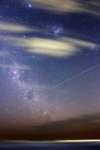 ISS and the Summer Milky Way
24.01.2013
Clouds on a summer night frame this sea and skyscape, recorded earlier this month near Buenos Aires, Argentina. But planet Earth's clouds are not the only clouds on the scene. Starry clouds...
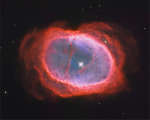 NGC 3132: The Southern Ring Nebula
9.04.2013
It's the dim star, not the bright one, near the center of NGC 3132 that created this odd but beautiful planetary nebula. Nicknamed the Eight-Burst Nebula and the Southern Ring Nebula, the glowing gas originated in the outer layers of a star like our Sun.
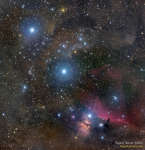 Alnitak, Alnilam, Mintaka
12.12.2013
Alnitak, Alnilam, and Mintaka, are the bright bluish stars from east to west (lower right to upper left) along the diagonal in this gorgeous cosmic vista. Otherwise known as the Belt of Orion, these three blue supergiant stars are hotter and much more massive than the Sun.
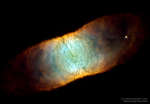 IC 4406: A Seemingly Square Nebula
8.01.2017
How can a round star make a square nebula? This conundrum comes to light when studying planetary nebulae like IC 4406. Evidence indicates that IC 4406 is likely a hollow cylinder, with its square appearance the result of our vantage point in viewing the cylinder from the side.
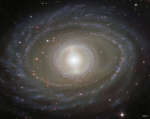 Ribbons and Pearls of Spiral Galaxy NGC 1398
23.01.2018
Why do some spiral galaxies have a ring around the center? Spiral galaxy NGC 1398 not only has a ring of pearly stars, gas and dust around its center, but a bar of stars and gas across its center, and spiral arms that appear like ribbons farther out.
 APOD: 2024 October 27 Б LDN 43: The Cosmic Bat Nebula
27.10.2024
What is the most spook-tacular nebula in the galaxy? One contender is LDN 43, which bears an astonishing resemblance to a vast cosmic bat flying amongst the stars on a dark Halloween night. Located...
|
January February March April May June July August September |
|||||||||||||||||||||||||||||||||||||||||||||||||