
|
You entered: color
 APOD: 2025 December 14 Б Juno Flyby of Ganymede and Jupiter
13.12.2025
What would it be like to fly over the largest moon in the Solar System? In 2021, the robotic Juno spacecraft flew past Jupiter's huge moon Ganymede and took images that have been digitally constructed into a detailed flyby.
 APOD: 2025 December 17 Б W5: The Soul Nebula
16.12.2025
Stars are forming in the Soul of the Queen of Aethopia. More specifically, a large star forming region called the Soul Nebula can be found in the direction of the constellation Cassiopeia, whom Greek mythology credits as the vain wife of a King who long ago ruled lands surrounding the upper Nile river.
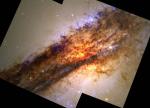 The Center of Centaurus A
1.10.2000
A fantastic jumble of young blue star clusters, gigantic glowing gas clouds, and imposing dark dust lanes surrounds the central region of the active galaxy Centaurus A. This mosaic of Hubble Space Telescope images taken in blue, green, and red light has been processed to present a natural color picture of this cosmic maelstrom.
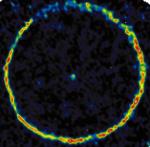 TT Cygni: Carbon Star
3.03.2001
TT Cygni is a cool red giant star with a wind. This false-color picture of TT Cyg was made using a coordinated array of millimeter wavelength radio telescopes and shows radio emission from carbon monoxide (CO) molecules in the surrounding gas.
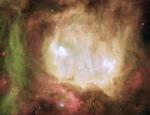 Halloween and the Ghost Head Nebula
30.10.2001
Halloween's origin is ancient and astronomical. Since the fifth century BC, Halloween has been celebrated as a cross-quarter day, a day halfway between an equinox (equal day / equal night) and a solstice (minimum day / maximum night in the northern hemisphere). With our modern calendar, however, the real cross-quarter day will occur next week.
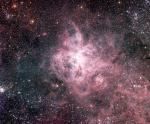 The Tarantula Zone
13.06.2002
The Tarantula Nebula is more than 1,000 light-years across - a giant emission nebula within our neighboring galaxy the Large Magellanic Cloud. Inside this cosmic arachnid lies a central young cluster of massive stars, cataloged as R136, whose intense radiation and strong winds have helped energize the nebular glow and shape the spidery filaments.
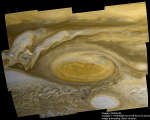 Jupiter's Great Red Spot from Voyager 1
2.05.2011
It is a hurricane twice the size of the Earth. It has been raging at least as long as telescopes could see it, and shows no signs of slowing. It is Jupiter's Great Red Spot, the largest swirling storm system in the Solar System.
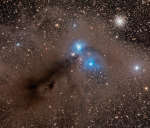 Stars and Dust Across Corona Australis
27.09.2012
Cosmic dust clouds sprawl across a rich field of stars in this sweeping telescopic vista near the northern boundary of Corona Australis, the Southern Crown. Probably less than 500 light-years away and effectively blocking...
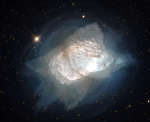 Bright Planetary Nebula NGC 7027 from Hubble
26.08.2013
It is one of the brightest planetary nebulae on the sky -- what should it be named? First discovered in 1878, nebula NGC 7027 can be seen toward the constellation of the Swan (Cygnus) with a standard backyard telescope.
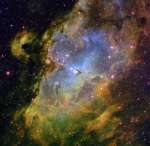 Inside the Eagle Nebula
16.02.2014
From afar, the whole thing looks like an Eagle. A closer look at the Eagle Nebula, however, shows the bright region is actually a window into the center of a larger dark shell of dust. Through this window, a brightly-lit workshop appears where a whole open cluster of stars is being formed.
|
January February |
|||||||||||||||||||||||||||||||||||||||||||||||||