
|
You entered: color
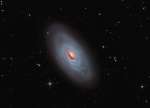 M64: The Black Eye Galaxy
4.04.2013
This beautiful, bright, spiral galaxy is Messier 64, often called the Black Eye Galaxy or the Sleeping Beauty Galaxy for its heavy-lidded appearance in telescopic views. M64 is about 17 million light-years distant in the otherwise well-groomed northern constellation Coma Berenices.
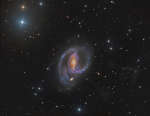 The Jets of NGC 1097
14.11.2013
Enigmatic spiral galaxy NGC 1097 shines in southern skies, about 45 million light-years away in the chemical constellation Fornax. Its blue spiral arms are mottled with pinkish star forming regions in this colorful galaxy portrait.
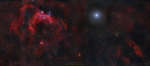 Seagull to Sirius
14.12.2016
This broad, beautiful mosaic spans almost 20 degrees across planet Earth's sky. The nebula-rich region lies near the edge of the Orion-Eridanus supperbubble, filled with looping, expanding shells of gas and dust embedded in molecular clouds near the plane of the Milky Way Galaxy.
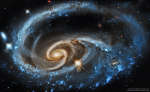 UGC 1810: Wildly Interacting Galaxy from Hubble
9.05.2017
What's happening to this spiral galaxy? Although details remain uncertain, it surely has to do with an ongoing battle with its smaller galactic neighbor. The featured galaxy is labelled UGC 1810 by itself, but together with its collisional partner is known as Arp 273.
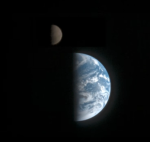 Earth and Moon
3.12.2017
On rare occasions, the Earth and Moon are photographed together. One of most spectacular times this occurred was 25 years ago this month when the Jupiter-bound Galileo spacecraft zoomed past our home planetary system. Then, robotic Galileo watched from about 15-times the Earth-Moon separation as our only natural satellite glided past our home world.
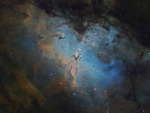 M16 Close Up
9.08.2019
A star cluster around 2 million years young surrounded by natal clouds of dust and glowing gas, M16 is also known as The Eagle Nebula. This beautifully detailed image of the region adopts the colorful Hubble palette and includes cosmic sculptures made famous in Hubble Space Telescope close-ups of the starforming complex.
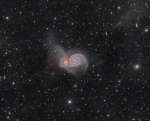 M51: The Whirlpool Galaxy
1.09.2022
Find the Big Dipper and follow the handle away from the dipper's bowl until you get to the last bright star. Then, just slide your telescope a little south and west and you'll come upon this stunning pair of interacting galaxies, the 51st entry in Charles Messier's famous catalog.
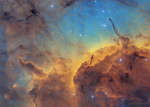 Stars, Dust, Pillars, and Jets in the Pelican Nebula
10.10.2022
What dark structures arise within the Pelican Nebula? On the whole, the nebula appears like a bird (a pelican) and is seen toward the constellation of a different bird: Cygnus, a Swan. But inside, the Pelican Nebula is a place lit up by new stars and befouled by dark dust.
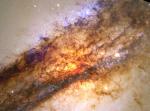 The Center of Centaurus A
21.04.2002
A fantastic jumble of young blue star clusters, gigantic glowing gas clouds, and imposing dark dust lanes surrounds the central region of the active galaxy Centaurus A. This mosaic of Hubble Space Telescope images taken in blue, green, and red light has been processed to present a natural color picture of this cosmic maelstrom.
 GL 105C: The Coolest Star?
20.09.1995
Is the dim star to the upper right of this false-color picture the coolest possible normal star? From this recent picture by the Hubble Space Telescope, astronomers have estimated its mass is just high enough for it to fuse hydrogen into helium in its core.
|
January February |
|||||||||||||||||||||||||||||||||||||||||||||||||