
|
You entered: color
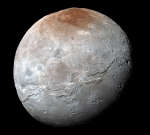 Charon: Moon of Pluto
2.10.2015
A darkened and mysterious north polar region informally known as Mordor Macula caps this premier high-resolution portrait of Charon, Pluto's largest moon. Captured by New Horizons near its closest approach on July 14, the image data was transmitted to Earth on September 21.
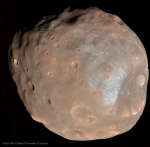 Phobos: Doomed Moon of Mars
22.11.2015
This moon is doomed. Mars, the red planet named for the Roman god of war, has two tiny moons, Phobos and Deimos, whose names are derived from the Greek for Fear and Panic. These...
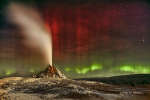 Aurora Over White Dome Geyser
2.10.2016
Sometimes both heaven and Earth erupt. Colorful aurorae erupted unexpectedly a few years ago, with green aurora appearing near the horizon and brilliant bands of red aurora blooming high overhead. A bright Moon lit the foreground of this picturesque scene, while familiar stars could be seen far in the distance.
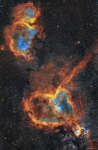 The Heart and Soul Nebulas
15.01.2019
Is the heart and soul of our Galaxy located in Cassiopeia? Possibly not, but that is where two bright emission nebulas nicknamed Heart and Soul can be found. The Heart Nebula, officially dubbed IC 1805 and visible in the featured image on the bottom right, has a shape reminiscent of a classical heart symbol.
 From the Pleiades to the Eridanus Loop
23.03.2020
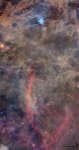
If you stare at an interesting patch of sky long enough, will it look different? In the case of Pleiades and Hyades star clusters -- and surrounding regions -- the answer is: yes, pretty different. Long...
 Half Sun with Prominence
2.11.2020
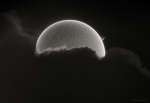
What's happening to the Sun? Clearly, the Sun's lower half is hidden behind a thick cloud. Averaging over the entire Earth, clouds block the Sun about 2/3rds of the time, although much less over many land locations. On the Sun's upper right is a prominence of magnetically levitating hot gas.
 Peculiar Galaxies of Arp 273
9.01.2025
The colorful, spiky stars are in the foreground of this image taken with a small telescope on planet Earth. They lie well within our own Milky Way Galaxy. But the two eye-catching galaxies in the frame lie far beyond the Milky Way, at a distance of over 300 million light-years.
 Saturnian Aurora
17.09.2000
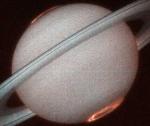
Girdling the second largest planet in the Solar System, Saturn's Rings are one of the most spectacular sights for earthbound telescopes. This image from the orbiting Hubble Space Telescope's STIS instrument, offers a striking view of another kind of ring around Saturn - pole encircling rings of ultraviolet aurora.
 Shells in the Egg Nebula
26.06.1999
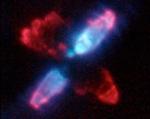
The Egg Nebula is taking a beating. Like a baby chick pecking its way out of an egg, the star in the center of the Egg Nebula is casting away shells of gas and dust as it slowly transforms itself into a white dwarf star.
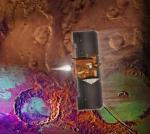 Odyssey at Mars
25.10.2001
After an interplanetary journey lasting 200 days, the Mars Odyssey spacecraft has entered orbit around the Red Planet. This latest success is welcome as in the past, Mars has often seemed a difficult planet to visit.
|
January February |
|||||||||||||||||||||||||||||||||||||||||||||||||