
|
You entered: time
 APOD: 2024 December 9 Б Pleiades: The Seven Sisters Star Cluster
8.12.2024
Have you ever seen the Pleiades star cluster? Even if you have, you probably have never seen it as large and clear as this. Perhaps the most famous star cluster on the sky, the bright stars of the Pleiades can be seen with the unaided eye even from the depths of a light-polluted city.
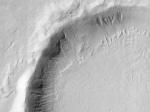 Melting Snow and the Gullies of Mars
20.02.2003
Tantalizing images of gullies on Mars have offered striking evidence for recent flows of liquid water. But Mars is too cold and its atmosphere too thin for liquid water to exist on the surface.
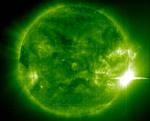 Flare Well AR 10486
5.11.2003
Almost out of view from our fair planet, rotating around the Sun's western edge, giant sunspot region AR 10486 lashed out with another intense solar flare followed by a large coronal mass ejection (CME) on Tuesday, November 4th at about 1950 Universal Time.
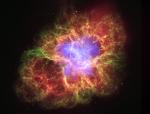 Composite Crab
26.10.2006
The Crab Nebula is cataloged as M1, the first object on Charles Messier's famous list of things which are not comets. In fact, the Crab is now known to be a supernova remnant, expanding debris from the death explosion of a massive star.
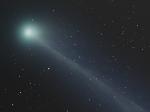 The Ghostly Tail of Comet SWAN
5.11.2006
What causes the structure in Comet SWAN's tail? Comet SWAN, which unexpectedly flared up to naked-eye brightness last week, has been showing detail in its ion tail that might be described as ghostly.
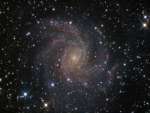 Facing NGC 6946
15.08.2008
From our vantage point in the Milky Way Galaxy, we see NGC 6946 face-on. The big, beautiful spiral galaxy is located just 10 million light-years away, behind a veil of foreground dust and stars in the high and far-off constellation of Cepheus.
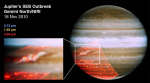 Dark Belt Reappearing on Jupiter
28.11.2010
Why are planet-circling clouds disappearing and reappearing on Jupiter? Although the ultimate cause remains unknown, planetary meteorologists are beginning to better understand what is happening. Earlier this year, unexpectedly, Jupiter's dark Southern Equatorial Belt (SEB) disappeared. The changes were first noted by amateurs dedicated to watching Jupiter full time.
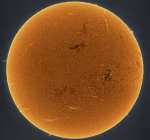 Orange Sun Scintillating
15.11.2011
Our Sun is becoming a busy place. Taken just last week, the Sun was captured sporting numerous interesting features including one of the larger sunspot groups yet recorded: AR 1339 visible on the image right. Only last year, the Sun was emerging from an unusually quiet Solar Minimum that lasted for years.
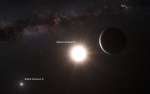 A View from Next Door
18.10.2012
Located just next door, Alpha Centauri is the closest star system to the Sun. A view from our interstellar neighbor a mere 4.3 light-years away is shown in this illustration. The Sun is at the upper right, a bright star against the background of the Milky Way.
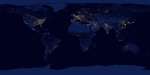 Earth at Night
7.12.2012
This remarkably complete view of Earth at night is a composite of cloud-free, nighttime images. The images were collected during April and October 2012 by the Suomi-NPP satellite from polar orbit about 824 kilometers (512 miles) above the surface using its Visible Infrared Imaging Radiometer Suite (VIIRS).
|
January February March April May June July August September |
|||||||||||||||||||||||||||||||||||||||||||||||||