
|
You entered: time
 Parker: Sounds of the Solar Wind
21.01.2020
What does the solar wind sound like? A wind of fast moving particles blows out from our Sun, and although space transmits sound poorly, particle impact and variable-field data from NASA's near-Sun Parker Solar Probe is being translated into sound.
 Triple Transit and Mutual Events
21.08.2021
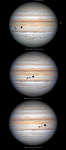
These three panels feature the Solar System's ruling gas giant Jupiter on August 15 as seen from Cebu City, Phillipines, planet Earth. On that date the well-timed telescopic views detail some remarkable performances, transits and mutual events, by Jupiter's Galilean moons.
 Distant Open Cluster M103
7.02.2001
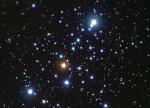
Bright blue stars highlight the open cluster known as M103. The gas clouds from which these stars condensed has long dispersed. Of the stars that were formed, the brightest, bluest, and most massive have already used up their nuclear fuel and self-destructed in supernova explosions.
 A Lucky Lunar Eclipse
3.04.1996
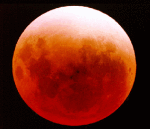
Tonight's full moon would normally washout the spectacle of Comet Hyakutake's lovely tail, even for those far from light polluted skies. Except that tonight comet observers are in luck - the dance of the planets calls for a total lunar eclipse! Lunar eclipses are caused when the Moon passes through the Earth's shadow.
 Leonids vs The Moon
20.11.2002
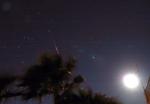
Beautiful and bright, the 2002 Leonid meteors battled against glaring moonlight. This winning example, from Tuesday morning skies above Laughlin, Nevada, USA, finds an undaunted Leonid streaking between the familiar constellation of Orion (left) and an overexposed full Moon.
 The Cone Nebula Neighborhood
12.04.2007
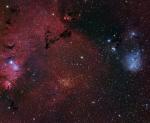
Cosmic clouds of hydrogen gas and dust abound in this gorgeous skyscape, stretching through Monocerous in the neighborhood of The Cone Nebula. A dark, obscuring dust cloud, the simple, sculpted shape of the Cone Nebula is near the lower left edge.
 Falling to Earth
10.02.2014
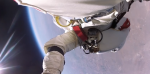
What would it be like to fall to Earth from really high up? A new record for the highest jump was accomplished in 2012 by Felix Baumgartner. Surpassing the previous record of 31.3 kilometer...
 Big Dipper Above and Below Chilean Volcanoes
9.05.2017
Do you see it? This common question frequently precedes the rediscovery of one of the most commonly recognized configurations of stars on the northern sky: the Big Dipper. This grouping of stars is one of the few things that has likely been seen, and will be seen, by every generation.
 Sharpless 308: The Dolphin Nebula
2.03.2020
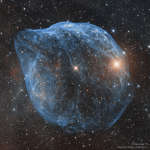
Blown by fast winds from a hot, massive star, this cosmic bubble is much larger than the dolphin it appears to be. Cataloged as Sharpless 2-308 it lies some 5,200 light-years away toward the constellation of the Big Dog (Canis Major) and covers slightly more of the sky than a Full Moon.
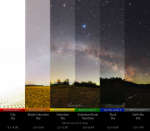 Country Sky versus City Sky
8.04.2020
Dark skies are disappearing from the world. With modernization comes artificial lighting that brightens the night. While these lights allow modern humans to see, much light is wasted up into the sky. This light...
|
January February March April May June July August September |
|||||||||||||||||||||||||||||||||||||||||||||||||