
|
You entered: time
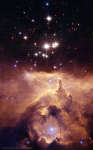 NGC 6357: Cathedral to Massive Stars
29.08.2020
How massive can a normal star be? Estimates made from distance, brightness and standard solar models had given one star in the open cluster Pismis 24 over 200 times the mass of our Sun, making it one of the most massive stars known.
 APOD: 2025 February 3 Б Wolf Rayet Star 124: Stellar Wind Machine
2.02.2025
Some stars explode in slow motion. Rare, massive Wolf-Rayet stars are so tumultuous and hot that they are slowly disintegrating right before our telescopes. Glowing gas globs each typically over 30 times more massive than the Earth are being expelled by violent stellar winds.
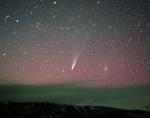 Ikeya Zhang: Comet Over Colorado
4.04.2002
Comet Ikeya-Zhang ("ee-KAY-uh JONG") has become a most photogenic comet. This lovely early evening view of the comet in Rocky Mountain skies looks northwest over ridges and low clouds. The time exposure was recorded on March 31st from an 8,000 foot elevation near Yampa, Colorado, USA.
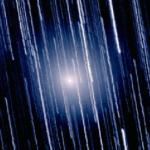 Tempel Tuttle: The Leonid Comet
15.11.2002
Star trails streak this composite time exposure of comet Tempel-Tuttle recorded by Tim Puckett on January 26, 1998. Then passing through the inner solar system on its 33 year orbit around the Sun, Tempel-Tuttle brightened unexpectedly, but binoculars or small telescopes were still required to visually observe it.
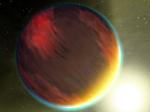 Atmospheres Detected on Two Extrasolar Planets
26.02.2007
Do extrasolar planets have water? In an attempt to find out, the orbiting Spitzer Space Telescope made detailed observations of the atmospheres of two planets that orbit stars other than our Sun. Unfortunately, water vapor was not detected in either exoplanet.
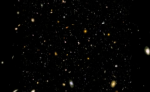 A Flight through the Hubble Ultra Deep Field
27.08.2013
What would it look like to fly through the distant universe? To find out, a team of astronomers estimated the relative distances to over 5,000 galaxies in one of the most distant fields of galaxies ever imaged: the Hubble Ultra Deep Field (HUDF).
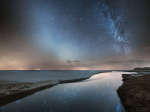 Dueling Bands in the Night
26.02.2018
What are these two bands in the sky? The more commonly seen band is the one on the right and is the central band of our Milky Way galaxy. Our Sun orbits...
 Our Rotating Earth
30.06.2020
Has your world ever turned upside-down? It would happen every day if you stay fixed to the stars. Most time-lapse videos of the night sky show the stars and sky moving above a steady Earth.
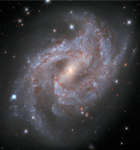 Supernova in NGC 2525
22.10.2020
Big, beautiful, barred spiral galaxy NGC 2525 lies 70 million light-years from the Milky Way. It shines in Earth's night sky within the boundaries of the southern constellation Puppis. About 60,000 light-years...
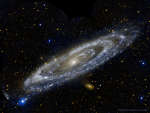 The Andromeda Galaxy in Ultraviolet
17.07.2021
What does the Andromeda galaxy look like in ultraviolet light? Young blue stars circling the galactic center dominate. A mere 2.5 million light-years away, the Andromeda Galaxy, also known as M31, really is just next door as large galaxies go.
|
January February March April May June July August September |
|||||||||||||||||||||||||||||||||||||||||||||||||