
|
You entered: space
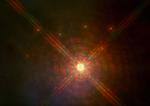 Young Suns
11.06.1997
The star cataloged as NGC2264 IRS is normally hidden from the inquiring gaze of optical telescopes. It resides in the midst of the obscuring gas and dust of a nearby star forming region popularly known as the Cone Nebula.
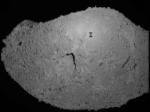 A Robots Shadow on Asteroid Itokawa
16.11.2005
What's that unusual looking spot on asteroid Itokawa? It's the shadow of the robot spacecraft Hayabusa that took the image. Japan's Hayabusa mission arrived at the asteroid in early September and has been imaging and maneuvering around the floating space mountain ever since. The above picture was taken earlier this month.
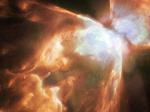 NGC 6302: Big, Bright, Bug Nebula
29.04.2007
The bright clusters and nebulae of planet Earth's night sky are often named for flowers or insects, and NGC 6302 is no exception. With an estimated surface temperature of about 250,000 degrees...
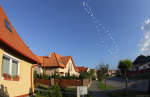 Analemma 2010
31.12.2010
Looking back on the year, have you wondered where the Sun was in the sky each day during 2010 at exacty 9am UT? Of course you have. Search no further for the answer! It was somewhere along this celestial figure 8 curve known as an analemma.
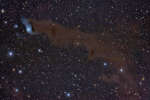 In Wolf s Cave
19.11.2011
The mysterious blue reflection nebula found in catalogs as VdB 152 or Ced 201 really is very faint. It lies at the tip of the long dark nebula Barnard 175 in a dusty complex that has also been called Wolf's Cave.
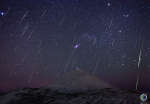 Geminid Meteors over Teide Volcano
17.12.2013
On some nights it rains meteors. Peaking two nights ago, asteroid dust streaked through the dark skies of Earth, showering down during the annual Geminids meteor shower. Astrophotographer Juan Carlos Casado captured the space weather event, as pictured above, in a series of exposures spanning about 2.3 hours using a wide angle lens.
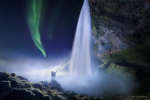 Lucid Dreaming
4.04.2016
Is this the real world? Or is it just fantasy? The truth started with a dream -- a dream that the spectacular Seljarlandsfoss waterfall in southern Iceland could be photographed with a backdrop of an aurora-filled sky. Soon after a promising space weather report, the visionary astrophotographer and his partner sprang into action.
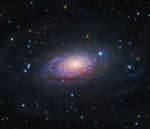 Messier 63: The Sunflower Galaxy
12.07.2017
A bright spiral galaxy of the northern sky, Messier 63 is about 25 million light-years distant in the loyal constellation Canes Venatici. Also cataloged as NGC 5055, the majestic island universe is nearly 100,000 light-years across. That's about the size of our own Milky Way Galaxy.
 Iron in the Butterfly Nebula
21.07.2020
Can stars, like caterpillars, transform themselves into butterflies? No, but in the case of the Butterfly Nebula -- it sure looks like it. Though its wingspan covers over 3 light-years and its estimated surface temperature...
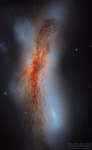 NGC 520: Colliding Galaxies from Hubble
7.09.2021
Is this one galaxy or two? The jumble of stars, gas, and dust that is NGC 520 is now thought to incorporate the remains of two separate disk galaxies. A defining component...
|
January February March April May June July August September |
|||||||||||||||||||||||||||||||||||||||||||||||||