
|
You entered: space
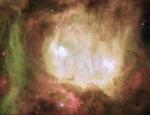 Halloween and the Ghost Head Nebula
31.10.2004
Halloween's origin is ancient and astronomical. Since the fifth century BC, Halloween has been celebrated as a cross-quarter day, a day halfway between an equinox (equal day / equal night) and a solstice (minimum day / maximum night in the northern hemisphere). With our modern calendar, however, the real cross-quarter day will occur next week.
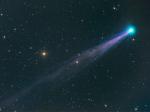 Comet SWAN Brightens
4.10.2006
A newly discovered comet has brightened enough to be visible this week with binoculars. The picturesque comet is already becoming a favored target for northern sky imagers. Pictured above just last week, Comet SWAN showed a bright blue-green coma and an impressive tail.
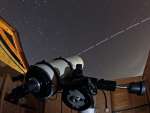 100 Hours of Astronomy Begins
2.04.2009
Today, 100 Hours of Astronomy begins, a cornerstone project of the International Year of Astronomy 2009 celebrating the 400th anniversary of Gallileo's original telescopic exploration of the sky. Running from April 2 through...
 Moon and Planets Over Catalonia
29.02.2012
Venus and Jupiter will appear unusually close in the sky over the next month. The planetary conjunction will be easily visible to the unaided eye because Venus will appear brighter than any background star, and Jupiter will be nearly as bright. To see the near-alignment, simply look to the west after sunset.
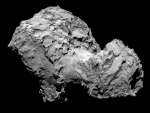 Rosetta s Rendezvous
7.08.2014
On August 3rd, the Rosetta spacecraft's narrow angle camera captured this stunning image of the nucleus of Comet 67P/Churyumov-Gerasimenko. After 10 years and 6.5 billion kilometers of travel along gravity assist trajectories looping through interplanetary space, Rosetta had approached to within 285 kilometers of its target.
 Solar Eclipse from a Ship
29.04.2023
Along a narrow path that mostly avoided landfall, the shadow of the New Moon raced across planet Earth's southern hemisphere on April 20 to create a rare annular-total or hybrid solar eclipse. From...
 The Circinus Galaxy
4.12.2000
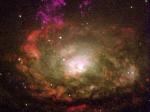
Powerful forces are at play in the nearby Circinus Galaxy. Hot gas, colored pink, is being ejected out of the spiral galaxy from the central region. Much of Circinus' tumultuous gas, however, is concentrated in two rings.
 POX 186: Not So Long Ago
3.01.2003
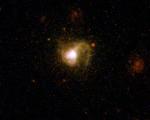
Not so long ago and not so far, far away, a galaxy was born. Seen in this Hubble Space Telescope image, the island universe of stars, gas, and dust cataloged as POX 186 is a mere 68 million light-years distant toward an uncrowded region in the constellation Virgo.
 Comet Kudo-Fujikawa: Days in the Sun
30.01.2003
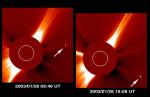
Cruising through the inner Solar System, new Comet Kudo-Fujikawa reached perihelion, its closest approach to the Sun, yesterday, January 29. Passing within 28.4 million kilometers of the Sun, this comet came much closer than innermost planet Mercury basking only 57.9 million kilometers from our parent star.
 The Egg Nebula in Polarized Light
9.04.2003
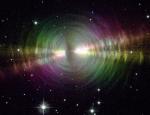
Where is the center of the unusual Egg Nebula? Like a baby chick pecking its way out of an egg, the star in the center of the Egg Nebula is casting away shells of gas and dust as it slowly transforms itself into a white dwarf star.
|
January February March April May June July August September |
|||||||||||||||||||||||||||||||||||||||||||||||||