
|
You entered: space
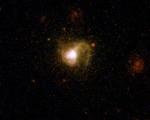 POX 186: Not So Long Ago
28.02.2004
Not so long ago and not so far, far away, a galaxy was born. Seen in this Hubble Space Telescope image, the island universe of stars, gas, and dust cataloged as POX 186 is a mere 68 million light-years distant toward an uncrowded region in the constellation Virgo.
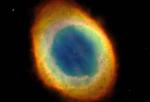 M57: The Ring Nebula
4.07.2004
Except for the rings of Saturn, the Ring Nebula (M57) is probably the most famous celestial band. This planetary nebula's simple, graceful appearance is thought to be due to perspective -- our view from planet Earth looking straight into what is actually a barrel-shaped cloud of gas shrugged off by a dying central star.
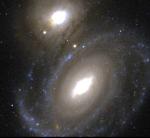 Galaxies Away
21.08.1999
This striking pair of galaxies is far, far away ... about 350 million light-years from Earth. Cataloged as AM0500-620, the pair is located in the southern constellation Dorado. The background elliptical and foreground spiral galaxy are representative of two of the three major classes of galaxies which inhabit our Universe.
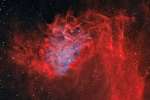 AE Aurigae and the Flaming Star Nebula
11.03.2011
AE Aurigae is the bright star below and left of center in this evocative portrait of IC 405, also known as the Flaming Star Nebula. Embedded in the cosmic cloud, the hot, variable O-type star energizes the glow of hydrogen along convoluted filaments of atomic gas, its blue starlight scattered by interstellar dust.
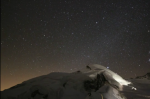 Geostationary Satellites Beyond the Alps
11.04.2012
Why don't those stars move? Stars in the sky will typically appear to rise and set as the Earth turns. Those far to the north or south will appear to circle the pole. If you look closely at the above time-lapse movie, however, there are points of light that appear stationary.
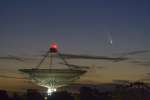 PanSTARRS over Parkes
9.03.2013
Sweeping quickly through southern skies on March 5, Comet PanSTARRS (C/2011 L4) follows the Sun toward the western horizon in this twilight scene. In the foreground is Australia's CSIRO Parkes Radio Telescope, a 64 meter wide steerable dish that is no stranger to the space age exploration of comets.
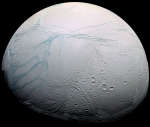 Fresh Tiger Stripes on Saturns Enceladus
6.04.2014
Do underground oceans vent through the tiger stripes on Saturn's moon Enceladus? Long features dubbed tiger stripes are known to be spewing ice from the moon's icy interior into space, creating a cloud of fine ice particles over the moon's South Pole and creating Saturn's mysterious E-ring.
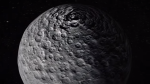 Fly Over Dwarf Planet Ceres
10.06.2015
What would it look like to fly over dwarf planet Ceres? Animators from the German Aerospace Center recently took actual images and height data from NASA's robotic Dawn mission -- currently visiting Ceres -- to generate several fascinating virtual sequences.
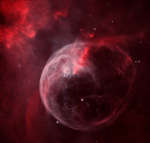 NGC 7635: The Bubble Nebula
19.04.2018
Blown by the wind from a massive star, this interstellar apparition has a surprisingly familiar shape. Cataloged as NGC 7635, it is also known simply as The Bubble Nebula. Although it looks delicate, the 7 light-year diameter bubble offers evidence of violent processes at work.
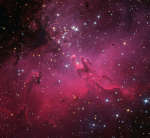 M16 and the Eagle Nebula
15.11.2019
A star cluster around 2 million years young surrounded by natal clouds of dust and glowing gas, M16 is also known as The Eagle Nebula. This beautifully detailed portrait of the region was made with groundbased narrow and broadband image data.
|
January February March April May June July August September |
|||||||||||||||||||||||||||||||||||||||||||||||||