
|
You entered: image
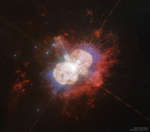 Doomed Star Eta Carinae
19.02.2019
Eta Carinae may be about to explode. But no one knows when - it may be next year, it may be one million years from now. Eta Carinae's mass - about 100 times greater than our Sun - makes it an excellent candidate for a full blown supernova.
 APOD: 2025 January 28 Б Comet G3 ATLAS over Uruguay
27.01.2025
Comets can be huge. When far from the Sun, a comet's size usually refers to its hard nucleus of ice and rock, which typically spans a few kilometers -- smaller than even a small moon.
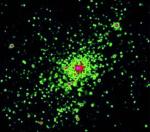 NGC 3603: X-Rays From A Starburst Cluster
23.01.2001
A mere 20,000 light-years from the Sun lies the NGC 3603 star cluster, a resident of the nearby Carina spiral arm of our Milky Way galaxy. Seen here in this recent false-color x-ray...
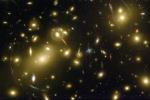 Abell 2218: A Galaxy Cluster Lens
7.10.2001
Gravity can bend light, allowing huge clusters of galaxies to act as telescopes. Almost all of the bright objects in this released Hubble Space Telescope image are galaxies in the cluster known as Abell 2218.
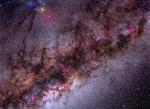 Our Galaxy in Stars, Gas, and Dust
27.09.1999
The disk of our Milky Way Galaxy is home to hot nebulae, cold dust, and billions of stars. The red nebulae visible in the above contrast-enhanced picture are primarily emission nebulae, glowing clouds of hydrogen gas heated by nearby, bright, young stars.
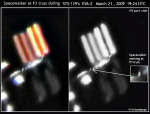 ISS and Astronaut
10.04.2009
These two frames, taken with a video camera and a telescope, reveal remarkable details of the International Space Station (ISS) orbiting some 350 kilometers above planet Earth. Recorded during last month's visit...
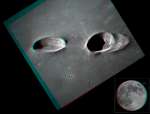 Messier Craters in Stereo
10.12.2009
Many bright nebulae and star clusters in planet Earth's sky are associated with the name of astronomer Charles Messier, from his famous 18th century catalog. His name is also given to these two large and remarkable craters on the Moon.
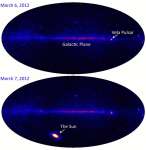 Solar Flare in the Gamma ray Sky
15.03.2012
What shines in the gamma-ray sky? The answer is usually the most exotic and energetic of astrophysical environments, like active galaxies powered by supermassive black holes, or incredibly dense pulsars, the spinning remnants of exploded stars.
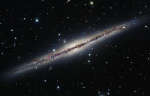 At the Edge of NGC 891
26.05.2012
This sharp cosmic portrait features NGC 891. The spiral galaxy spans about 100 thousand light-years and is seen almost exactly edge-on from our perspective. In fact, about 30 million light-years distant in the constellation Andromeda, NGC 891 looks a lot like our Milky Way.
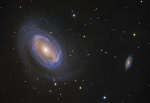 One Armed Spiral Galaxy NGC 4725
30.05.2013
While most spiral galaxies, including our own Milky Way, have two or more spiral arms, NGC 4725 has only one. In this sharp color composite image, the solo spira mirabilis seems to wind from a prominent ring of bluish, newborn star clusters and red tinted star forming regions.
|
January February March April May June July August September |
|||||||||||||||||||||||||||||||||||||||||||||||||