
|
You entered: image
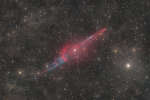 The Bipolar Jets of KX Andromedae
4.12.2025
Blasting outward from variable star KX Andromedae, these stunning bipolar jets are 19 light-years long. Recently discovered, they are revealed in unprecedented detail in this deep telescopic image centered on KX And and composed from over 692 hours of combined image data.
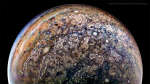 APOD: 2026 January 6 Б Jupiters Clouds in High Definition from Juno
5.01.2026
How complex is Jupiter? NASA's Juno mission to Jupiter is finding the Jovian giant to be more complicated than expected. Jupiter's magnetic field has been discovered to be much different from our Earth's simple dipole field, showing several poles embedded in a complicated network more convoluted in the north than the south.
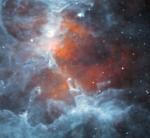 Cold Dust in the Eagle Nebula
14.09.2001
Stars are born in M16's Eagle Nebula, a stellar nursery 7,000 light-years from Earth toward the constellation Serpens. The striking nebula's star forming pillars of gas and dust are familiar to astronomers from images at visible wavelengths, but this false-color picture shows off the nebula in infrared light.
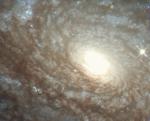 NGC 4414: A Flocculent Spiral Galaxy
3.04.2002
How much mass do flocculent spirals hide? The above true color image of flocculent spiral galaxy NGC 4414 was taken with the Hubble Space Telescope to help answer this question. Flocculent spirals -- galaxies without well defined spiral arms -- are a quite common form of galaxy, and NGC 4414 is one of the closest.
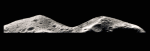 NEAR to an Asteroid
14.02.1996
Excitement mounts as NASA's Near Earth Asteroid Rendezvous (NEAR) spacecraft nears launch - currently scheduled for 3:53 ET on February 16. NEAR's mission is to become the first spacecraft to rendezvous with and orbit an asteroid, the asteroid designated 433 Eros.
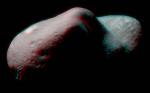 Stereo Eros
28.02.2003
Get out your red/blue glasses and float next to asteroid 433 Eros, 170 million kilometers away! Orbiting the Sun once every 1.8 earth-years, asteroid Eros is a diminutive 40 x 14 x 14 kilometer world of undulating horizons, craters, boulders and valleys.
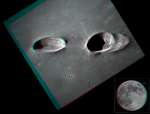 Messier Craters in Stereo
29.05.2015
Many bright nebulae and star clusters in planet Earth's sky are associated with the name of astronomer Charles Messier, from his famous 18th century catalog. His name is also given to these two large and remarkable craters on the Moon.
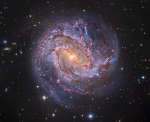 M83: The Thousand Ruby Galaxy
7.10.2015
Big, bright, and beautiful, spiral galaxy M83 lies a mere twelve million light-years away, near the southeastern tip of the very long constellation Hydra. Prominent spiral arms traced by dark dust lanes and blue star clusters lend this galaxy its popular name, The Southern Pinwheel.
 NGC 6357: The Lobster Nebula
6.02.2017
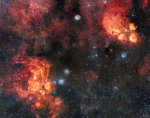
Why is the Lobster Nebula forming some of the most massive stars known? No one is yet sure. Near the more obvious Cat's Paw nebula on the upper right, the Lobster Nebula...
 NGC 6188: The Dragons of Ara
6.11.2018
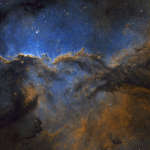
Dark shapes with bright edges winging their way through dusty NGC 6188 are tens of light-years long. The emission nebula is found near the edge of an otherwise dark large molecular cloud in the southern constellation Ara, about 4,000 light-years away.
|
January February March April May June July August September |
|||||||||||||||||||||||||||||||||||||||||||||||||