
|
You entered: image
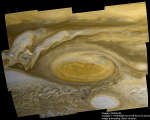 Jupiter's Great Red Spot from Voyager 1
2.05.2011
It is a hurricane twice the size of the Earth. It has been raging at least as long as telescopes could see it, and shows no signs of slowing. It is Jupiter's Great Red Spot, the largest swirling storm system in the Solar System.
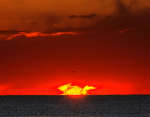 A Strange Sunrise Over Argentina
10.10.2011
Why would a rising Sun look so strange? No one is yet sure. What is clear is that the above unusual sunrise was captured last month from Buenos Aires, Argentina. The body of water in the foreground is Rio de La Plata, considered by many to be the widest river in the world.
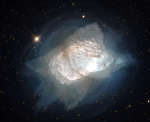 Bright Planetary Nebula NGC 7027 from Hubble
26.08.2013
It is one of the brightest planetary nebulae on the sky -- what should it be named? First discovered in 1878, nebula NGC 7027 can be seen toward the constellation of the Swan (Cygnus) with a standard backyard telescope.
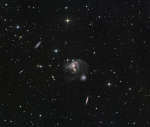 Hickson 91 in Piscis Austrinus
24.03.2016
Scanning the skies for galaxies, Canadian astronomer Paul Hickson and colleagues identified some 100 compact groups of galaxies, now appropriately called Hickson Compact Groups (HCGs). This sharp telescopic image captures one such galaxy group, HCG 91, in beautiful detail.
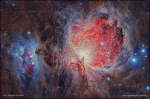 M42: The Great Orion Nebula
29.11.2017
Few astronomical sights excite the imagination like the nearby stellar nursery known as the Orion Nebula. The Nebula's glowing gas surrounds hot young stars at the edge of an immense interstellar molecular cloud.
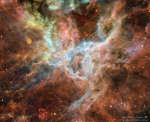 In the Heart of the Tarantula Nebula
20.05.2018
In the heart of monstrous Tarantula Nebula lies huge bubbles of energetic gas, long filaments of dark dust, and unusually massive stars. In the center of this heart, is a knot of stars so dense that it was once thought to be a single star.
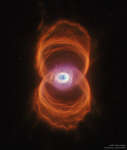 MyCn 18: The Engraved Hourglass Planetary Nebula
29.09.2019
Do you see the hourglass shape -- or does it see you? If you can picture it, the rings of MyCn 18 trace the outline of an hourglass -- although one with an unusual eye in its center. Either way, the sands of time are running out for the central star of this hourglass-shaped planetary nebula.
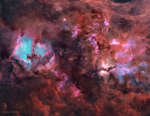 Cygnus Without Stars
30.11.2020
The sky is filled with faintly glowing gas, though it can take a sensitive camera and telescope to see it. For example, this twelve-degree-wide view of the northern part of the constellation Cygnus reveals a complex array of cosmic clouds of gas along the plane of our Milky Way galaxy.
 M16: Inside the Eagle Nebula
28.12.2020
From afar, the whole thing looks like an Eagle. A closer look at the Eagle Nebula, however, shows the bright region is actually a window into the center of a larger dark shell of dust. Through this window, a brightly-lit workshop appears where a whole open cluster of stars is being formed.
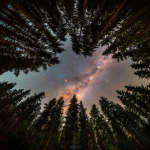 Framed by Trees: A Window to the Galaxy
19.07.2021
The photographer had this shot in mind for some time. He knew that objects overhead are the brightest -- since their light is scattered the least by atmospheric air. He also that knew the core of our Milky Way Galaxy was just about straight up near midnight around this time of year in South Australia.
|
January February March April May June July August September |
|||||||||||||||||||||||||||||||||||||||||||||||||