
|
You entered: sand
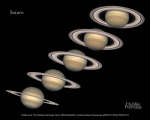 The Seasons of Saturn
21.07.2013
Since Saturn's axis is tilted as it orbits the Sun, Saturn has seasons, like those of planet Earth ... but Saturn's seasons last for over seven years. So what season is it on Saturn now? Orbiting the equator, the tilt of the rings of Saturn provides quite a graphic seasonal display.
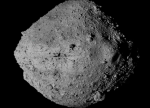 Places for OSIRIS REx to Touch Asteroid Bennu
23.12.2019
Where is the best place to collect a surface sample from asteroid Bennu? Launched in 2016, NASA sent the robotic Origins, Spectral Interpretation, Resource Identification, Security, Regolith Explorer (OSIRIS-REx) to investigate the 500-meter-across asteroid 101955 Bennu.
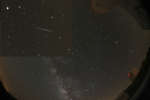 A Twisted Meteor Trail Over Tenerife
2.06.2010
Did this meteor take a twisting path? No one is sure. Considered opinions are solicited. Meteors, usually sand sized grains that originate in comets, will typically disintegrate as they enter the Earth's atmosphere. A fast moving meteor ionizes molecules in the Earth's atmosphere that subsequently glow when they reacquire electrons.
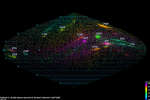 Forty Thousand Meteor Origins Across the Sky
11.05.2009
Where do meteors come from? Visible meteors are typically sand-sized grains of ice and rock that once fragmented from comets. Many a meteor shower has been associated with a known comet, although some intriguing orphan showers do remain.
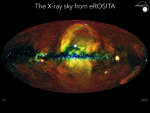 The X Ray Sky from eROSITA
23.06.2020
What if you could see X-rays? The night sky would seem a strange and unfamiliar place. X-rays are about 1,000 times more energetic than visible light photons and are produced by violent explosions and high temperature astronomical environments.
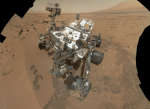 Curiosity Rover at Rocknest on Mars
27.12.2012
What's in this smooth soil on Mars? In late October, NASA's robotic Curiosity rover stopped near a place dubbed Rocknest as it continues to explore Gale Crater on Mars. Rocknest is the group of stones seen near the top left of the above image -- just to the left of Curiosity's mast.
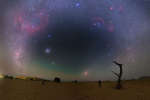 A Gegenschein Lunar Eclipse
14.10.2015
Is there anything interesting to see in the direction opposite the Sun? One night last month, there were quite a few things. First, the red-glowing orb on the lower right of the featured image is the full moon, darkened and reddened because it has entered Earth's shadow.
|
January February March April May June July August September |
|||||||||||||||||||||||||||||||||||||||||||||||||