
|
You entered: sand
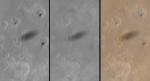 The Shadow of Phobos
28.03.2003
Hurtling through space above the Red Planet, potato-shaped Phobos completes an orbit of Mars in less than eight hours. In fact, since its orbital period is shorter than the planet's rotation period, Mars-based...
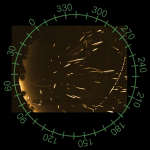 Perseids from Perseus
17.08.2009
Where are all of these meteors coming from? In terms of direction on the sky, the pointed answer is the constellation of Perseus. That is why the last week's meteor shower was known as the Perseids -- the meteors all appear to come from a radiant toward Perseus.
 Beagle Crater on Mars
19.09.2006
What have we found on the way to large Victoria Crater? Smaller Beagle Crater. The robotic Opportunity rover rolling across Mars stopped at Beagle Crater early last month and took an impressively detailed 360-degree panorama of the alien Martian landscape. Beagle crater appears in the center as a dip exposing relatively dark sand.
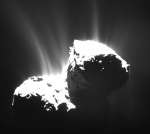 Jets from Comet Churyumov Gerasimenko
2.02.2015
Where do comet tails come from? Although it is common knowledge that comet tails and comas originate from comet nuclei, exactly how that happens is an active topic of research. One of the best...
 Eight Kilometers Above Titan
18.01.2005
What are these surface features on Titan? Scroll right to see the panoramic view captured last week by the Huygens probe as it descended toward Saturn's mysterious moon. Scientists are not yet sure what the above image is showing.
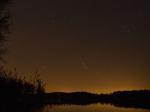 A Leonid Meteor Over Sweden
20.11.2006
This past weekend, small remnant bits of a distant comet lit up the skies over much of planet Earth. Incoming reports, however, have this year's Leonid meteor shower as less active than Leonid meteor showers a few years ago.
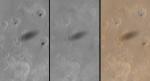 Shadow Of Phobos
4.11.1999
Hurtling through space above the Red Planet, potato-shaped Phobos completes an orbit of Mars in less than eight hours. In fact, since its orbital period is shorter than the planet's rotation period, Mars-based...
 Lyrid Meteors from the Constellation Lyra
11.05.2020
Where are all of these meteors coming from? In terms of direction on the sky, the pointed answer is the constellation of Small Harp (Lyra). That is why the famous meteor shower that peaks every April is known as the Lyrids -- the meteors all appear to came from a radiant toward Lyra.
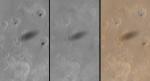 The Shadow of Phobos
17.09.2005
(xxxedit and linkxxx) Hurtling through space above the Red Planet, potato-shaped Phobos completes an orbit of Mars in less than eight hours. In fact, since its orbital period is shorter than the planet...
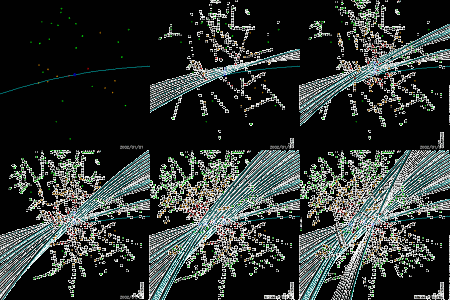 Animation of Asteroids Passing Near Earth
28.03.2006
How often does an asteroid whiz by the Earth? The above time-lapse animation follows the orbit of the Earth around the Sun for two months in 2002 as numerous asteroids, also known as minor planets, approach and pass by. Some asteroids appear out of nowhere as they are plotted only when they were discovered.
|
January February March April May June July August September |
|||||||||||||||||||||||||||||||||||||||||||||||||