
|
You entered: sand
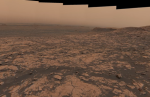 Curiosity Vista from Vera Rubin Ridge
9.09.2018
If you could stand on Mars -- what might you see? If you were NASA's Curiosity rover, just last month you would have seen the view from Vera Rubin Ridge, an intriguing rock-strewn perch on the side of Mount Sharp.
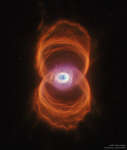 MyCn 18: The Engraved Hourglass Planetary Nebula
28.09.2019
Do you see the hourglass shape -- or does it see you? If you can picture it, the rings of MyCn 18 trace the outline of an hourglass -- although one with an unusual eye in its center. Either way, the sands of time are running out for the central star of this hourglass-shaped planetary nebula.
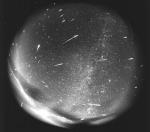 Leonids from Leo
15.11.2003
Is Leo leaking? Leo, the famous sky constellation visible on the left of the above all-sky photograph, appears to be the source of all the meteors seen in 1998's Leonids Meteor Shower. That...
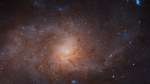 The Stars of the Triangulum Galaxy
22.02.2019
Like grains of sand on a cosmic beach, stars of the Triangulum Galaxy are resolved in this sharp mosaic from the Hubble Space Telescope's Advanced Camera for Surveys (ACS). The inner region of the galaxy spanning over 17,000 light-years is covered at extreme resolution, the second largest image ever released by Hubble.
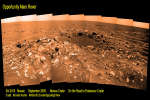 Nereus Crater on Mars
19.10.2009
It was along the way. The robotic rover Opportunity currently rolling across the Meridiani Plain on Mars has a destination of Endeavour Crater, a large crater over 20 kilometers across which may yield additional clues about the cryptic past of ancient Mars.
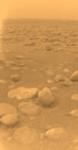 Titan Landscape
16.01.2005
This color view from Titan gazes across a suddenly familiar but distant landscape on Saturn's largest moon. The scene was recorded by ESA's Huygens probe after a 2 1/2 hour descent through a thick atmosphere of nitrogen laced with methane.
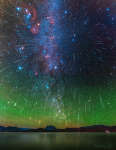 Geminids from Gemini
15.11.2021
Where are all of these meteors coming from? In terms of direction on the sky, the pointed answer is the constellation of Gemini. That is why the major meteor shower in December is known as the Geminids -- because shower meteors all appear to come from a radiant toward Gemini.
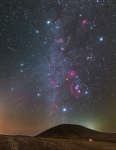 Orionids Meteors over Inner Mongolia
29.10.2018
Meteors have been shooting out from the constellation of Orion. This was expected, as October is the time of year for the Orionids Meteor Shower. Pictured here, over two dozen meteors were caught in successively added exposures last October over Wulan Hada volcano in Inner Mongolia, China.
 A Perseid Meteor
11.08.2004
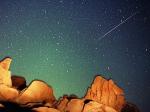
The ongoing Perseid Meteor Shower should be at its strongest tonight and tomorrow night. Although meteors should be visible all night long, the best time to watch will be between 2:00 AM and dawn each night. In dark, moonless, predawn skies you may see dozens of meteors per hour.
 NASAs Curiosity Rover at Namib Dune (360 View)
28.03.2016
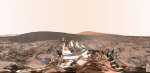
Point or tilt to see a spectacular view of Mars visible to the Curiosity rover last December. In the foreground, part of Curiosity itself is visible, including its dusty sundial. Starting about seven meters...
|
January February March April May June July August September |
|||||||||||||||||||||||||||||||||||||||||||||||||