
|
You entered: Earth
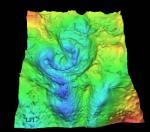 Impact: 65 Million Years Ago
26.02.2000
What killed the dinosaurs? Their sudden disappearance 65 million years ago, along with about 70 percent of all species then living on Earth, is known as the K-T event (Cretaceous-Tertiary Mass Extinction event). Geologists and paleontologists often entertain the idea that a large asteroid
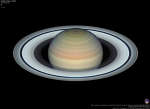 Saturn near Opposition
17.06.2017
Saturn reached its 2017 opposition on June 16. Of course, opposition means opposite the Sun in Earth's sky and near opposition Saturn is up all night, at its closest and brightest for the year.
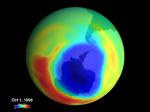 The Worlds Largest Ozone Hole
14.10.1998
It's back, and it's bigger than ever. The ozone hole that has been a cause of concern in recent years has again reformed over Earth's South Pole. The seasonal recurrence of the ozone hole was expected, although the size of the hole has never been so large this early in the season.
 Discovery Spring
20.03.2001
Welcome to the equinox! Moving northward in Earth's sky, today the Sun crosses the celestial equator at 13:31 Universal Time bringing Spring to the north and Fall to the south. The change...
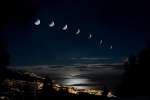 Eclipse at Moonset
29.12.2010
Hugging the horizon, a dark red Moon greeted early morning skygazers in eastern Atlantic regions on December 21, as the total phase of 2010's Solstice Lunar Eclipse began near moonset. This well composed...
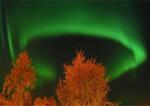 Aurora s Ring
15.10.2002
Gusting solar winds and blasts of charged particles from the Sun made the early days of October rewarding ones for those anticipating aurora. While out enjoying the stormy space weather from Toemmeraas, Norway, Trygve Lindersen recorded this picturesque apparition of the northern lights with a digital camera on October 6.
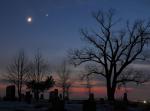 December Moon Meets Evening Star
9.12.2005
If you've been outdoors near sunset, then you've probably noticed Venus low in the west as the brilliant evening star. Sometimes mistaken for a tower light near the horizon, Venus is the third brightest celestial beacon, after the Sun and Moon, in planet Earth's sky.
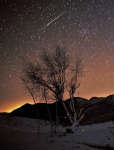 A Meteor Moment
17.12.2010
Intensely bright, this fireball meteor flashed through Tuesday's cold, clear, early morning skies over the Karakas Mountains in central Iran, near the peak of the annual Geminid Meteor Shower. To capture the meteor moment and wintery night skyscape, the photographer's camera was fixed to a tripod, its shutter open for about 1.5 minutes.
 The Veins of Heaven
19.06.2020
Transfusing sunlight through a darkened sky, this beautiful display of noctilucent clouds was captured earlier this week, reflected in calm waters from Nykobing Mors, Denmark. From the edge of space, about 80 kilometers above...
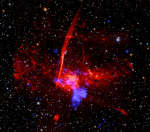 APOD: 2026 June 18 Б Possible Supernova Remnant in Galactic Center
18.06.2026
Do you see that blue blob to the lower right of the image center? Astronomers think that it shows where a massive star exploded as a supernova whose light reached Earth 1,700 years ago.
|
January February March April May June July August September October |
|||||||||||||||||||||||||||||||||||||||||||||||||