
|
You entered: Earth
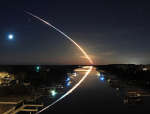 Waterway to Orbit
13.02.2010
The 32nd shuttle mission to the International Space Station, STS-130, left planet Earth on February 8. Its early morning launch to orbit from Kennedy Space Center's pad 39A followed the long, graceful, eastward arc seen in this 2 minute time exposure.
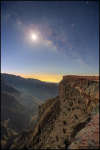 Milky Way in Moonlight
23.04.2016
A waning crescent moon, early morning twilight, and Al Hamra's city lights on the horizon can't hide the central Milky Way in this skyscape from planet Earth. Captured in a single exposure...
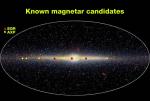 Magnetars In The Sky
26.11.2004
Indicated on this infrared image of the galactic center region are positions of candidate magnetars -- believed to be the strongest magnets in the galaxy. Classified by observers as Soft Gamma Repeaters (SGRs) and Anomalous X-ray Pulsars (AXPs), these cosmic powerhouses are likely city-sized, spinning, highly-magnetized neutron stars. How strong is a magnetar's magnetic field?
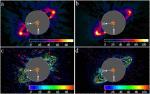 HR 4796A: Not Saturn
5.02.1999
These are not false-color renderings of the latest observations of Saturn's magnificent rings. Instead, the panels show a strikingly similar system on a much larger scale - a ring around the young, Vega-like star, HR 4796A, located about 200 light-years from Earth.
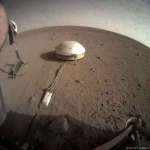 SEIS: Listening for Marsquakes
4.06.2019
If you put your ear to Mars, what would you hear? To find out, and to explore the unknown interior of Mars, NASA's Insight Lander deployed SEIS late last year, a sensitive seismometer that can detect marsquakes.
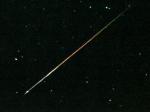 Rainbow Perseid
16.08.2002
While meteors do show colors, the colors aren't always seen with the unaided eye. Still, high speed color film recorded this rainbow-like trail as a meteor streaked through the early morning sky on August 13 above Sedona, Arizona, USA.
 Planet Line over New York Bridge
20.04.2022
There's an interesting sky to see if you wake up before the Sun. Lined up on toward the eastern horizon are four planets in a row. The planets are so bright they can even be seen from the bright sky inside a city.
 APOD: 2025 August 30 Б A Two Percent Moon
30.08.2025
A young crescent moon can be hard to see. That's because when the Moon shows it's crescent phase (young or old) it can never be far from the Sun in planet Earth's sky.
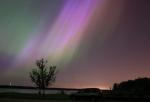 Aurora Iowa
20.05.2005
Early last Sunday morning stars were not the only lights in Iowa skies. The northern lights also shone from the heavens, extending across the midwestern USA and other locations not often graced with auroral displays.
 Our Story in One Minute
14.11.2012
Could you tell the story of human existence in a minute? This thrilling video culls together multiple teasing snippets in an attempt to do just that. And sets it to music. Briefly depicted, from...
|
January February March April May June July August September October |
|||||||||||||||||||||||||||||||||||||||||||||||||