
|
You entered: nearest stars
 Facing NGC 1232
18.04.2024
From our vantage point in the Milky Way Galaxy, we see NGC 1232 face-on. Nearly 200,000 light-years across, the big, beautiful spiral galaxy is located some 47 million light-years away in the flowing southern constellation of Eridanus. This sharp, multi-color, telescopic image of NGC 1232 includes remarkable details of the distant island universe.
 APOD: 2025 November 25 Б Comet Lemmon and the Milky Way
25.11.2025
What did Comet Lemmon look like when it was at its best? One example is pictured here, featuring three celestial spectacles all at different distances. The closest spectacle is the snowcapped Meili Mountains, part of the Himalayas in China.
 Comet C 2023 E1 ATLAS near Perihelion
14.07.2023
Comet C/2023 E1 (ATLAS) was just spotted in March, another comet found by the NASA funded Asteroid Terrestrial-impact Last Alert System. On July 1 this Comet ATLAS reached perihelion, its closest approach to the Sun.
 Hubble s Andromeda Galaxy Mosaic
21.02.2025
The largest photomosaic ever assembled from Hubble Space Telescope image data is a panoramic view of our neighboring spiral Andromeda Galaxy. With 600 overlapping frames assembled from observations made from July 2010 to December 2022, the full Hubble Andromeda Galaxy mosaic spans almost six full moons across planet Earth's sky.
 Barnards Loop around the Horsehead Nebula
17.04.2006
Why is the Horsehead Nebula surrounded by a bubble? Although glowing like an emission nebula, the origin of the bubble, known as Barnard's Loop, is currently unknown. Progenitor hypotheses include the winds from bright Orion stars and the supernovas of stars long gone.
 A Quasar Portrait Gallery
6.12.1997
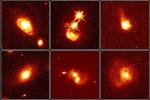
QUASARs (QUASi-stellAR objects) lie near the edge of the observable Universe. Discovered in 1963, astronomers were astounded that such objects could be visible across billions of light-years, as this implies they must emit prodigious amounts of energy. Where does the energy come from?
 A Quasar Portrait Gallery
9.03.2002
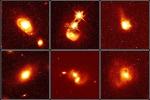
Quasars (QUASi-stellAR objects) lie near the edge of the observable Universe. Discovered in 1963, astronomers were astounded that such objects could be visible across billions of light-years, as this implies they must emit prodigious amounts of energy. Where does the energy come from?
 The Light, the Dark, and the Dusty
10.01.2024
This colorful skyscape spans about three full moons across nebula rich starfields along the plane of our Milky Way Galaxy toward the royal northern constellation Cepheus. Near the edge of the region's massive...
 Spitzer s Milky Way
5.06.2008
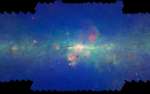
The Spitzer Space Telescope's encompasing infrared view of the plane of our Milky Way Galaxy is hard to appreciate in just one picture. In fact, more than 800,000 frames of data from...
 When Z is for Mars
15.04.2023
A composite of images captured about a week apart from mid August 2022 through late March 2023, this series traces the retrograde motion of ruddy-colored Mars. Progressing from lower right to upper left Mars...
|
January February March April May June July August September October |
|||||||||||||||||||||||||||||||||||||||||||||||||