
|
You entered: Sun
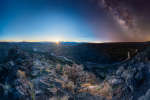 A Flow of Time
8.04.2020
This surreal timelapse, landscape, panorama spans predawn, blue hour, and sunrise skies. Close to the start of planet Earth's northern hemisphere spring, the flow of time was captured between 4:30 and 7:00 am from a location overlooking northern New Mexico's Rio Grande Valley.
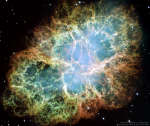 M1: The Crab Nebula from Hubble
5.09.2020
This is the mess that is left when a star explodes. The Crab Nebula, the result of a supernova seen in 1054 AD, is filled with mysterious filaments. The filaments are not only tremendously...
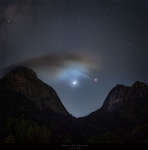 Venus and Mars: Passing in the Night
28.03.2022
When two planets pass on the night sky, they can usually be seen near each other for a week or more. In the case of this planetary conjunction, Venus and Mars passed within 4 degrees of each other earlier this month.
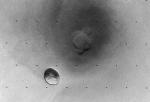 Phobos Over Mars
12.03.1999
Hurtling through space a mere 3,000 miles above the Martian surface, the diminutive moon Phobos (below and left of center) was imaged against the backdrop of a large shield volcano by the Viking 2 Orbiter in 1977.
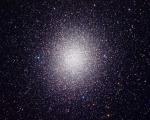 Millions of Stars in Omega Centauri
16.04.2002
Pictured above is the largest ball of stars in our Galaxy. About 10 million stars orbit the center of this globular cluster - named Omega Centauri - as this giant globular cluster orbits our Galactic center.
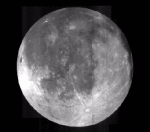 Earth's Moon, A Familiar Face
3.09.1995
The above mosaic of the Earth's Moon was compiled from photos taken by the spacecraft Clementine in 1994. This image represents the side of the Moon familiar to Earth dwellers. The Moon revolves around the Earth about once every 28 days.
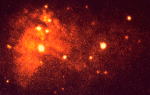 LMC X-1: A Black Hole Candidate
29.12.1995
The strongest source of X-rays in the Large Magellanic Cloud originates from an unusually energetic binary star system. This strong source, dubbed LMC X-1, is thought to be a normal and compact star orbiting each other. Gas stripped of the normal star falls onto the compact star, heats up, and emits X-rays.
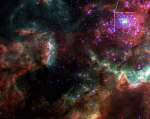 In the Center of 30 Doradus
24.05.1996
In the center of 30 Doradus lies a huge cluster of the largest, hottest, most massive stars known. The center of this cluster, known as R136, is boxed in the upper right portion of the above picture.
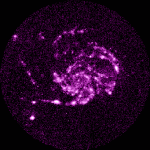 An Ultraviolet Image of M101
27.06.1995
This giant spiral galaxy, Messier 101 (M101), was photographed by the Ultraviolet Imaging Telescope onboard the Space Shuttle Endeavour during the Astro-2 mission (March 2 - 18, 1995). The image has been computer processed so that the colors represent the intensity of ultraviolet light.
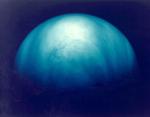 Venus: Just Passing By
29.09.2002
Venus, the second closest planet to the Sun, is a popular way-point for spacecraft headed for the gas giant planets in the outer reaches of the solar system. Why visit Venus first? Using...
|
January February |
|||||||||||||||||||||||||||||||||||||||||||||||||