
|
You entered: gas
 APOD: 2024 February 7 Б The Heart Shaped Antennae Galaxies
7.02.2024
Are these two galaxies really attracted to each other? Yes, gravitationally, and the result appears as an enormous iconic heart -- at least for now. Pictured is the pair of galaxies cataloged as NGC 4038 and NGC 4039,known as the Antennae Galaxies.
 The Variable Nebula NGC 2261
31.01.2025
The interstellar cloud of dust and gas captured in this sharp telescopic snapshot is seen to change its appearance noticeably over periods as short as a few weeks. Discovered over 200 years ago and cataloged as NGC 2261, bright star R Monocerotis lies at the tip of the fan-shaped nebula.
 Titan: Moon over Saturn
3.05.2025
Like Earth's moon, Saturn's largest moon Titan is locked in synchronous rotation with its planet. This mosaic of images recorded by the Cassini spacecraft in May of 2012 shows its anti-Saturn side, the side always facing away from the ringed gas giant.
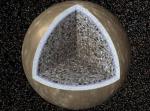 Cutaway Callisto: Ice, Rock, and Ocean
6.11.1998
Cruising past the moons of reigning gas giant Jupiter, Voyager and Galileo have returned tantalizing evidence for a liquid water ocean beneath the surface of Europa. Now researchers are reporting telltale indications that the battered Jovian moon Callisto may also harbor a subsurface
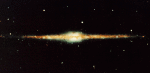 The Milky Way's Center
15.03.1997
Although the Earth is round, our Galaxy appears truly flat. This was shown in dramatic fashion by the COsmic Background Explorer (COBE) satellite which produced this premier view of the central region of our own Milky Way Galaxy in infrared light in1990.
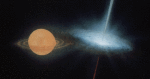 Jets from SS433
13.04.1997
SS433 is one of the most exotic star systems known. Its unremarkable name stems from its inclusion in a catalog of stars which emit radiation characteristic of atomic hydrogen. Its very remarkable behavior stems from a compact object, a black hole or neutron star, which has produced an accretion disk with jets.
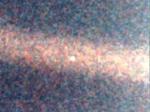 APOD: 2006 January 1- The Largest Rock in the Solar System
1.01.2006
There, that faint dot in the center - that's the largest rock known in our Solar System. It is larger than every known asteroid, moon, and comet nucleus. It is larger than any other local rocky planet.
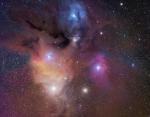 The Colorful Clouds of Rho Ophiuchi
14.07.2006
This stunning mosiac of the sky around bright stars Antares (Alpha Scorpii) and Rho Ophiuchi reveals spectacular colors in a cosmic starscape. Near the top, Rho Ophiuchi and nearby stars are immersed in blue reflection nebulae - dust clouds that shine primarily by reflected starlight.
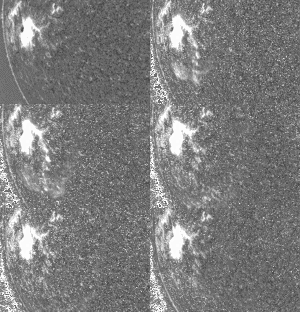 A Large Tsunami Shock Wave on the Sun
13.12.2006
Tsunami's this large don't happen on Earth. One week ago, a large solar flare from an Earth-sized sunspot produced a tsunami-type shock wave that was spectacular even for the Sun. Pictured above...
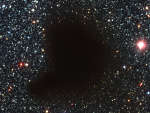 Molecular Cloud Barnard 68
23.03.2008
Where did all the stars go? What used to be considered a hole in the sky is now known to astronomers as a dark molecular cloud. Here, a high concentration of dust and molecular gas absorb practically all the visible light emitted from background stars.
|
January February March April May |
|||||||||||||||||||||||||||||||||||||||||||||||||