
|
You entered: gas
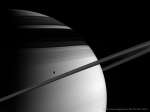 Saturn, Tethys, Rings, and Shadows
5.04.2015
Seen from ice moon Tethys, rings and shadows would display fantastic views of the Saturnian system. Haven't dropped in on Tethys lately? Then this gorgeous ringscape from the Cassini spacecraft will have to do for now.
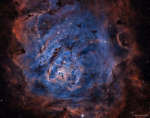 The Lagoon Nebula in Hydrogen Sulfur and Oxygen
5.01.2016
The majestic Lagoon Nebula is filled with hot gas and the home for many young stars. Spanning 100 light years across while lying only about 5000 light years distant, the Lagoon Nebula is so big and bright that it can be seen without a telescope toward the constellation of the Archer (Sagittarius).
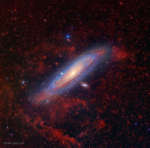 Clouds of Andromeda
8.01.2018
What are those red clouds surrounding the Andromeda galaxy? This galaxy, M31, is often imaged by planet Earth-based astronomers. As the nearest large spiral galaxy, it is a familiar sight with dark dust lanes, bright yellowish core, and spiral arms traced by clouds of bright blue stars.
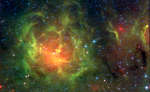 Spitzer s Trifid
13.02.2020
The Trifid Nebula, also known as Messier 20, is easy to find with a small telescope. About 30 light-years across and 5,500 light-years distant it's a popular stop for cosmic tourists in the nebula rich constellation Sagittarius.
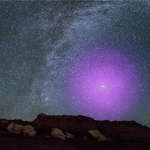 A Halo for Andromeda
3.09.2020
M31, the Andromeda Galaxy, is the closest large spiral galaxy to our Milky Way. Some 2.5 million light-years distant it shines in Earth's night sky as a small, faint, elongated cloud just visible to the unaided eye.
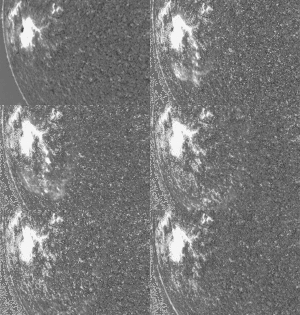 A Large Tsunami Shock Wave on the Sun
22.05.2022
Tsunamis this large don't happen on Earth. During 2006, a large solar flare from an Earth-sized sunspot produced a tsunami-type shock wave that was spectacular even for the Sun. Pictured here, the tsunami...
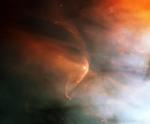 LL Orionis: When Cosmic Winds Collide
13.03.2002
This arcing, graceful structure is actually a bow shock about half a light-year across, created as the wind from young star LL Orionis collides with the Orion Nebula flow. Adrift in Orion's stellar...
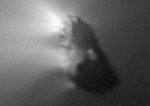 Comet Halley's Nucleus
10.12.1996
Here is what a comet nucleus really looks like. For all active comets except Halley, it was only possible to see the surrounding opaque gas cloud called the coma. During Comet Halley's most...
 Irregular Moons Discovered Around Uranus
3.11.1997
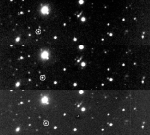
Where did these two irregular moons of Uranus originate? Last week two previously undiscovered moons of the distant gas planet were confirmed, the first in irregular orbits. All fifteen previously known moons of Uranus are 'regular', circling near the planet's equator. Most of these were discovered by the passing Voyager 2 spacecraft in 1986.
 30 Doradus: The Tarantula Zone
12.12.2005
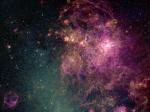
The Tarantula Nebula is more than 1,000 light-years across - a giant emission nebula within our neighboring galaxy the Large Magellanic Cloud. Inside this cosmic arachnid lies a central young cluster of massivestars, cataloged as R136, whose intense radiation and strong winds have helped energize the nebular glow and shape the spidery filaments.
|
January February March April May |
|||||||||||||||||||||||||||||||||||||||||||||||||