
|
You entered: gas
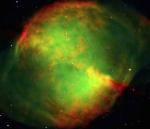 M27: Not A Comet
24.04.2004
While searching the skies above 18th century France for comets, astronomer Charles Messier diligently recorded this object as number 27 on his list of things which are definitely not comets. So what is it?
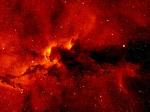 IC 1396 Close Up
30.09.2005
Clouds of glowing hydrogen gas mingle ominously with dark dust lanes in this close-up of IC 1396, an active star forming region some 2,000 light years away in the constellation Cepheus. In this and other similar emission nebulae, energetic ultraviolet light from a hot young star strips electrons from the surrounding hydrogen atoms.
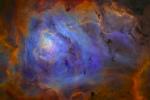 Blue Lagoon
25.08.2006
Stars come and go as you slide your cursor over this engaging image of M8, aka the Lagoon Nebula. Of course, the nebula is itself a star-forming region, but the stars that appear and disappear here include background and foreground stars that by chance lie along the same line of sight.
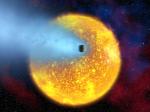 Water Claimed in Evaporating Planet HD 209458b
17.04.2007
Planet HD 209458b is evaporating. It is so close to its parent star that its heated atmosphere is simply expanding away into space. Some astronomers studying this distant planetary system now believe they have detected water vapor among the gases being liberated.
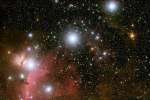 Orion s Belt
10.02.2009
Alnitak, Alnilam, and Mintaka, are the bright bluish stars from east to west (left to right) along the diagonal in this gorgeous cosmic vista. Otherwise known as the Belt of Orion, these three blue supergiant stars are hotter and much more massive than the Sun.
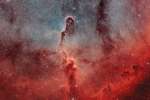 The Elephant's Trunk in IC 1396
6.11.2010
Like an illustration in a galactic Just So Story, the Elephant's Trunk Nebula winds through the emission nebula and young star cluster complex IC 1396, in the high and far off constellation of Cepheus. Of course, the cosmic elephant's trunk is over 20 light-years long.
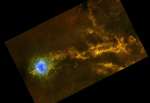 Herschel s Cocoon
19.08.2011
In this remarkable infrared skyscape of interstellar clouds adrift in the high flying constellation Cygnus, the eye is drawn to the Cocoon Nebula. Also known as IC5146, the dusty star forming region is shown...
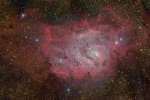 M8: The Lagoon Nebula
17.08.2013
This beautiful cosmic cloud is a popular stop on telescopic tours of the constellation Sagittarius. Eighteenth century cosmic tourist Charles Messier cataloged the bright nebula as M8. Modern day astronomers recognize the Lagoon Nebula as an active stellar nursery about 5,000 light-years distant, in the direction of the center of our Milky Way Galaxy.
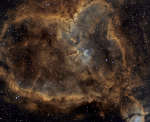 IC 1805: Light from the Heart
14.02.2014
Sprawling across almost 200 light-years, emission nebula IC 1805 is a mix of glowing interstellar gas and dark dust clouds about 7,500 light-years away in the Perseus spiral arm of our galaxy. Stars were born in this region whose nickname, the Heart Nebula, derives from its Valentine's-Day-appropriate shape.
 The Protoplanetary Disk of HL Tauri from ALMA
9.11.2014
Why does this giant disk have gaps? The exciting and probable answer is: planets. A mystery is how planets massive enough to create these gaps formed so quickly, since the HL Tauri star system is only about one million years old.
|
January February March April May |
|||||||||||||||||||||||||||||||||||||||||||||||||