
|
You entered: stars
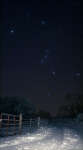 Sideways Orion Over Snowy Ireland
26.12.2010
Orion always comes up sideways ... and was caught in the act earlier this month by over a snowy landscape in Donegal, Ireland. To compose this serene picture, the photographer found a picturesque setting to the east, waited until after sunset, and then momentarily lit the foreground with a flashlight.
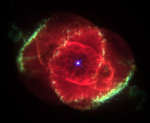 The Cats Eye Nebula
26.08.2012
Three thousand light-years away, a dying star throws off shells of glowing gas. This image from the Hubble Space Telescope reveals the Cat's Eye Nebula to be one of the most complex planetary nebulae known.
 The Heart and Soul Nebulas
11.02.2014
Is the heart and soul of our Galaxy located in Cassiopeia? Possibly not, but that is where two bright emission nebulas nicknamed Heart and Soul can be found. The Heart Nebula, officially dubbed IC 1805 and visible in the above zoomable view on the right, has a shape reminiscent of a classical heart symbol.
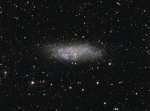 Wolf-Lundmark-Melotte
7.04.2016
Named for the three astronomers instrumental in its discovery and identification, Wolf - Lundmark - Melotte (WLM) is a lonely dwarf galaxy. Seen toward the mostly southern constellation Cetus, about 3 million light-years from the Milky Way, it is one of the most remote members of our local galaxy group.
 The Cats Eye Nebula
3.07.2016
Three thousand light-years away, a dying star throws off shells of glowing gas. This image from the Hubble Space Telescope reveals the Cat's Eye Nebula to be one of the most complex planetary nebulae known.
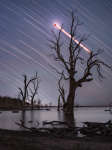 APOD: 2026 March 13 Б Toolondo Totality Trails
13.03.2026
In this composited night skyscape, stacked exposures trace graceful star trails above Lake Toolondo, Victoria, Australia, planet Earth. Captured while the lunar eclipse of March 3 was in progress, the exposures used were made during the hour-long total eclipse phase.
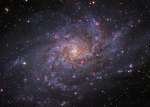 M33: Triangulum Galaxy
20.12.2012
The small, northern constellation Triangulum harbors this magnificent face-on spiral galaxy, M33. Its popular names include the Pinwheel Galaxy or just the Triangulum Galaxy. M33 is over 50,000 light-years in diameter, third largest in the Local Group of galaxies after the Andromeda Galaxy (M31), and our own Milky Way.
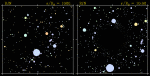 Too Close to a Black Hole
10.12.2000
What would you see if you went right up to a black hole? Above are two computer generated images highlighting how strange things would look. On the left is a normal star field containing the constellation Orion. Notice the three stars of nearly equal brightness that make up Orion's Belt.
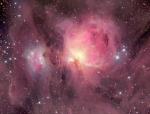 M42: Wisps of the Orion Nebula
25.02.2003
The Great Nebula in Orion, an immense, nearby starbirth region, is probably the most famous of all astronomical nebulas. Here, glowing gas surrounds hot young stars at the edge of an immense interstellar molecular cloud only 1500 light-years away. In the above deep image, faint wisps and sheets of dust and gas are particularly evident.
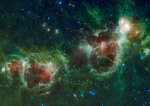 WISE: Heart and Soul Nebulas in Infrared
1.06.2010
Is the heart and soul of our Galaxy located in Cassiopeia? Possibly not, but that is where two bright emission nebulas nicknamed Heart and Soul can be found. The Heart Nebula, officially dubbed IC 1805 and visible in the above right, has a shape in optical light reminiscent of a classical heart symbol.
|
January February March April May June July August September |
|||||||||||||||||||||||||||||||||||||||||||||||||