
|
You entered: stars
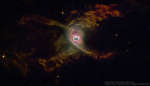 The Red Spider Planetary Nebula
19.04.2017
Oh what a tangled web a planetary nebula can weave. The Red Spider Planetary Nebula shows the complex structure that can result when a normal star ejects its outer gases and becomes a white dwarf star.
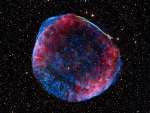 SN 1006 Supernova Remnant
4.07.2008
A new star, likely the brightest supernova in recorded human history, lit up planet Earth's sky in the year 1006 AD. The expanding debris cloud from the stellar explosion, found in the southerly constellation of Lupus, still puts on a cosmic light show across the electromagnetic spectrum.
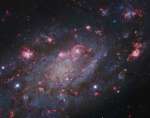 NGC 2403 in Camelopardalis
23.07.2011
Magnificent island universe NGC 2403 stands within the boundaries of the long-necked constellation Camelopardalis. Some 10 million light-years distant and about 50,000 light-years across, the spiral galaxy also seems to have more than its fair share of giant star forming HII regions, marked by the telltale reddish glow of atomic hydrogen gas.
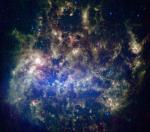 The Large Magellanic Cloud in Infrared
4.09.2006
Where does dust collect in galaxies? To help find out, a team of researchers took the most detailed image ever of gas clouds and dust in the neighboring Large Magellanic Cloud (LMC) galaxy.
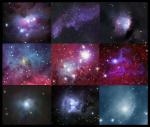 Starlight Reflections
28.12.2001
Interstellar dust grains often find themselves in a reflective "mood". Near a bright star, clouds of these dust particles scatter short wavelengths of visible starlight more readily than long wavelengths, producing lovely blue reflection nebulae. Nine of the more spectacular examples of these dusty, blue stellar neighborhoods have been assembled here by astrophotographer Rob Gendler.
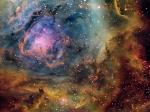 The Busy Center of the Lagoon Nebula
3.08.2005
Stars are battling gas and dust in the Lagoon Nebula but the photographers are winning. Also known as M8, this photogenic nebula is visible even without binoculars towards the constellation of Sagittarius. The energetic processes of star formation create not only the colors but the chaos.
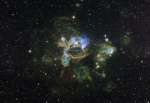 The N44 Complex
27.03.2008
A truly giant complex of emission nebulae, N44 is about 1,000 light-years across. It shines in southern skies as a denizen of our neighboring galaxy, the Large Magellanic Cloud, 170,000 light-years away.
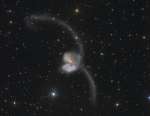 The Antennae
29.04.2011
Some 60 million light-years away in the southerly constellation Corvus, two large galaxies collided. But the stars in the two galaxies, cataloged as NGC 4038 and NGC 4039, don't collide in the course of the ponderous event, lasting hundreds of millions of years.
 Portrait of an Infant Solar System
7.06.2002
This infant solar system was discovered posing along the lonely outskirts of the Rho Ophiuchi dark cloud, a star forming region 500 light-years from Earth. Enlarged in this infrared false-color portrait from the European...
 The Turbulent Neighborhood of Eta Carina
26.11.2003
How do violent stars affect their surroundings? To help find out, astronomers pointed the Hubble Space Telescope to the regions surrounding Eta Carina, a star showing signs that it may explode sometime in the next million years.
|
January February March April May June July August September |
|||||||||||||||||||||||||||||||||||||||||||||||||