
|
You entered: color
 Orion and the Running Man
13.11.2025
Few cosmic vistas can excite the imagination like The Great Nebula in Orion. Visible as a faint, bland celestial smudge to the naked-eye, the nearest large star-forming region sprawls across this sharp colorful telescopic image. Designated M42 in the Messier Catalog, the Orion Nebula's glowing gas and dust surrounds hot, young stars.
 Portrait of NGC 1055
27.11.2025
Big, beautiful spiral galaxy NGC 1055 is a dominant member of a small galaxy group a mere 60 million light-years away toward the aquatically intimidating constellation Cetus. Seen edge-on, the island universe spans over 100,000 light-years, a little larger than our own Milky Way galaxy.
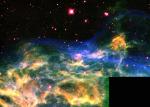 At the Edge of the Crescent Nebula
2.08.2000
The Crescent Nebula is a rapidly expanding shell of gas surrounding a dying star. In this recently released image by the Hubble Space Telescope, a bright dynamic part of the nebula three light-years across is shown in representative color.
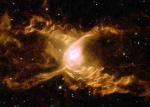 The Red Spider Planetary Nebula
24.07.2001
Oh what a tangled web a planetary nebula can weave. The Red Spider Planetary Nebula shows the complex structure that can result when a normal star ejects its outer gases and becomes a white dwarf star.
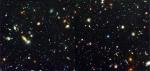 The Deep Field
9.02.1997
Galaxies like colorful pieces of candy fill the Hubble Deep Field - humanity's most distant yet optical view of the Universe. The dimmest, some as faint as 30th magnitude (about four billion times fainter...
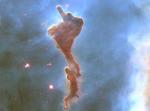 Disappearing Clouds in Carina
30.06.2003
This dense cloud of gas and dust is being deleted. Likely, within a few million years, the intense light from bright stars will have boiled it away completely. Stars not yet formed in the molecular cloud's interior will then stop growing.
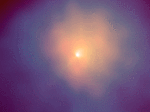 Hyakutake: Comet Atmosphere
10.04.1998
The atmosphere of a comet comes and goes. Approaching the sun, it swells as material from the icy cometary nucleus is warmed and evaporated by increasing sunlight. Immense but tenuous and fleeting, the inner atmosphere or inner "coma" of comet Hyakutake is seen in this false color picture.
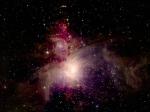 Orion Nebula: The 2MASS View
12.06.1998
Few astronomical sights excite the imagination like the nearby stellar nursery known as the Orion Nebula. The Nebula's glowing gas surrounds hot young stars at the edge of an immense interstellar molecular cloud only 1,500 light-years away.
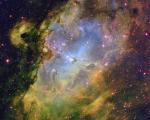 Inside the Eagle Nebula
24.10.2004
From afar, the whole thing looks like an Eagle. A closer look at the Eagle Nebula, however, shows the bright region is actually a window into the center of a larger dark shell of dust. Through this window, a brightly-lit workshop appears where a whole open cluster of stars is being formed.
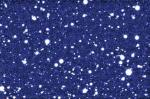 The Backyard Universe
14.04.1999
How far can you see from your own backyard? Across the Solar System, even across our Galaxy, these sights are not difficult. Recently, however, amateur Paul Boltwood gazed across the universe. His record setting image is shown above in false color.
|
January February |
|||||||||||||||||||||||||||||||||||||||||||||||||