
|
You entered: color
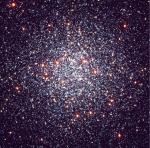 M55: Globular Star Cluster
18.09.2004
The fifty-fifth entry in Charles Messier's catalog, M55 is a large and lovely globular cluster of around 100,000 stars. Only 20,000 light-years away in the constellation Sagittarius, M55 appears to earth-bound observers to be nearly 2/3 the size of the full moon.
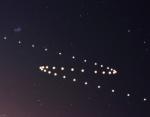 Z is for Mars
22.04.2006
This composite of images spaced about a week apart - from late July 2005 (bottom right) through February 2006 (top left) - traces the retrograde motion of ruddy-colored Mars through planet Earth's night sky. On November 7th, 2005 the Red Planet was opposite the Sun in Earth's sky (at opposition).
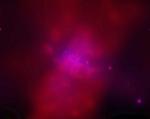 M82: Starburst in X-rays
21.04.2000
Star formation occurs at a faster pace in M82 -- a galaxy with about 10 times the rate of massive star birth (and death) compared to our Milky Way. Winds from massive stars and blasts...
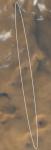 Mars Polar Lander Target Ellipse
4.12.1999
South is up in this recent composite color picture of Mars Polar Lander's target region near the Martian South Pole taken on November 28. Imaged by the orbiting Mars Global Surveyor's wide angle camera, the area covered is 105 kilometers across with the expected landing ellipse superposed.
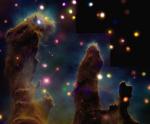 APOD: 2007 February 24- X rays and the Eagle Nebula
24.02.2007
The premier Chandra X-ray Observatory images of M16, the Eagle Nebula, show many bright x-ray sources in the region. Most of the x-ray sources are energetic young stars. They are seen here as colored spots superimposed on the Hubble's well-known optical view of M16's light-year long Pillars of Creation.
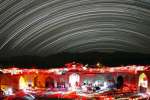 Running Messier s Marathon
19.04.2008
Gripped by an astronomical spring fever, many northern hemisphere stargazers embark on a Messier Marathon. Completing the marathon requires viewing all 110 objects in 18th century French astronomer Charles Messier's catalog in one glorious dusk-to-dawn observing run.
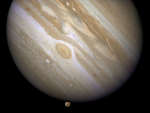 Jupiter Eclipsing Ganymede
6.01.2009
How hazy is Jupiter's upper atmosphere? To help find out, astronomers deployed the Hubble Space Telescope to watch Jupiter eclipse its moon Ganymede. Although Ganymede circles Jupiter once a week, it usually passes above or below the planet, so that a good eclipse occurs more rarely.
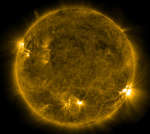 Equinox and the Iron Sun
23.09.2010
Today, the Sun crosses the celestial equator heading south at 03:09 Universal Time. Known as an equinox, this astronomical event marks the first day of autumn in the northern hemisphere and spring in the south. Equinox means equal night.
 Sunspot Group 1429 and the Distant Sun
19.03.2012
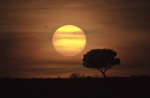
What's that on the Sun? Over the past two weeks, one of the most energetic sunspot regions of recent years crossed the face of the Sun. Active Region 1429, visible above...
 NGC 2736: The Pencil Nebula
24.09.2012
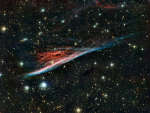
This shock wave plows through space at over 500,000 kilometers per hour. Moving toward to bottom of this beautifully detailed color composite, the thin, braided filaments are actually long ripples in a sheet of glowing gas seen almost edge on. Cataloged as NGC 2736, its narrow appearance suggests its popular name, the Pencil Nebula.
|
January February |
|||||||||||||||||||||||||||||||||||||||||||||||||