
|
You entered: sky
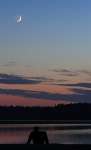 Calm, Crescent Moon, and Venus
21.05.2010
Last weekend, the Moon and Venus formed a beautiful close pair in the west after sunset, a scene enjoyed by skygazers all over the world. In this lovely view of the conjunction from Sweden, a calm lake Vallentuna lies in the foreground with sunset colors still fading behind the treeline on the far shore.
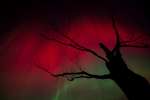 October Skylights
28.10.2011
As northern hemisphere nights grow longer, October is a good month for spotting auroras, or even other eerie apparitions after dark. And this week the night sky did not disappoint. On October 24th a solar coronal mass ejection impacted planet Earth's magnetosphere triggering far ranging auroral displays.
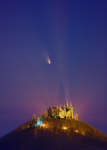 Comet Castle
22.03.2013
The broad dust tail of Comet PanSTARRS (C/2011 L4) has become a familiar sight for many northern hemisphere comet watchers, as the comet fades but rises higher above the western horizon after sunset. This view of the popular comet may seem a little fantastic, though.
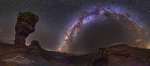 Milky Way and Stone Tree
29.04.2013
What's that next to the Milky Way? An unusual natural rock formation known as Roque Cinchado or Stone Tree found on the Spanish Canary Island of Tenerife. A famous icon, Roque Cinchado is likely a dense plug of cooled volcanic magma that remains after softer surrounding rock eroded away.
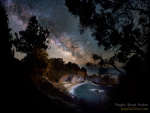 Galaxy Cove Vista
7.05.2013
To see a vista like this takes patience, hiking, and a camera. Patience was needed in searching out just the right place and waiting for just the right time. A short hike was needed to reach this rugged perch above a secluded cove in Julia Pfeiffer Burns State Park in California, USA.
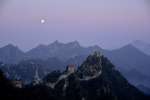 The Great Wall by Moonlight
12.03.2015
Last Friday, an almost Full Moon rose as the Sun set, over this mountainous landscape north of Beijing, China. Also near apogee, the farthest point in its elliptical orbit around planet Earth, it was this year's smallest and faintest Full Moon.
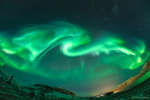 Dragon Aurora over Norway
10.04.2018
What's that in the sky? An aurora. A large coronal hole opened last month, a few days before this image was taken, throwing a cloud of fast moving electrons, protons, and ions toward the Earth.
 The Reappearance of Mars
11.09.2020
Mars reappears just beyond the Moon's dark limb in this stack of sharp video frames captured on September 6. Of course to reappear it had to disappear in the first place.
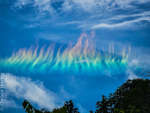 A Fire Rainbow over West Virginia
30.08.2021
What's happening to this cloud? Ice crystals in a distant cirrus cloud are acting like little floating prisms. Known informally as a fire rainbow for its flame-like appearance, a circumhorizon arc appears parallel to the horizon.
 Mars Saturn Conjunction
9.04.2022
Fainter stars in the zodiacal constellation Capricornus are scattered near the plane of the ecliptic in this field of view. The two brightest ones at center aren't stars at all though, but the planets Mars and Saturn.
|
January February March April May June July August September October |
|||||||||||||||||||||||||||||||||||||||||||||||||