
|
You entered: sky
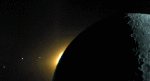 The Ecliptic Plane
14.10.2000
The Plane of the Ecliptic is well illustrated in this picture from the 1994 lunar prospecting Clementine spacecraft. Clementine's star tracker camera image reveals (from right to left) the Moon lit by Earthshine, the Sun's corona rising over the Moon's dark limb, and the planets Saturn, Mars, and Mercury.
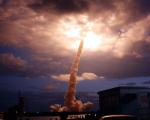 Columbia Dawn
8.03.2002
Trailing a thick column of exhaust, the Space Shuttle Columbia blasted into the twilight morning sky on March 1, its thundering rockets briefly flooding a cloud bank with the light of a false dawn. The event marked the start of the ongoing eleven day mission to upgrade the Hubble Space Telescope.
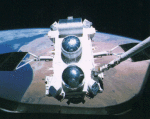 The Compton Gamma Ray Observatory
11.08.1995
The Compton Gamma Ray Observatory (CGRO) was the most massive instrument ever launched by a NASA Space Shuttle and continues to revolutionize gamma-ray astronomy. This orbiting observatory sees the sky in gamma-ray photons - light so blue humans can't see it.
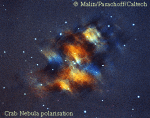 M1: Polarization of the Crab
23.11.1995
The Crab Nebula resulted from a star that exploded - a supernova. Although the stellar explosion that caused the Crab Nebula was seen over 900 years ago, the nebula itself still expands and shines. Much of the emitted light has been found to be polarized. Light waves with the same polarization vibrate in the same plane.
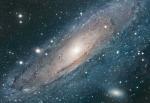 M31: The Andromeda Galaxy
21.10.2002
Andromeda is the nearest major galaxy to our own Milky Way Galaxy. Our Galaxy is thought to look much like Andromeda. Together these two galaxies dominate the Local Group of galaxies. The diffuse light from Andromeda is caused by the hundreds of billions of stars that compose it.
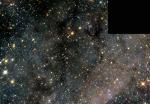 A Magellanic Starfield
4.01.2003
Stars of many types and colors are visible in this Hubble Space Telescope close-up of a starfield in the Large Magellanic Cloud (LMC). Over 10,000 stars are visible -- the brightest of which are giant stars. Were our Sun at the distance of these stars, about 170,000 light-years, it would hardly be discernable.
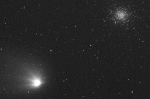 Comet Hale-Bopp Passes M14
12.11.1996
Comet Hale-Bopp continues its slow trek across the night sky, and can now be seen superposed near the bright globular cluster M14. Will Comet Hale-Bopp become as bright in early 1997 as Comet Hyakutake did in early 1996? It is still too early to tell.
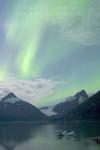 Aurora Over the Chugach Mountains
29.09.2003
Auroras can make spectacular sights. Photographed above, flowing green auroras help the Moon illuminate the serene Portage Lake and the snowy Chugach Mountains near Anchorage, Alaska, USA. Although auroras might first appear to be moonlit clouds, they only add light to the sky and do not block background stars from view.
 Leonids 1998: A Safe Meteor Storm
16.11.1998
You're in no danger. During the meteor storm occurring tonight and tomorrow, thousands of bits of ice and rock will likely rain onto the Earth. Few, if any, will hit the ground. Touted as potentially the most active meteor shower since 1966, the Leonids of 1998 will be tracked by observers the world over.
 A Meteor Over the Anza Borrego Desert
11.08.1999
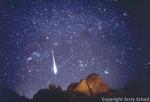
Meteors will be flashing across your skies over the next two nights. Specifically, the Perseid Meteor Shower should be at its best just before each morning's dawn. Observers at dark locations might see as much as a meteor a minute.
|
January February March April May June July August September October |
|||||||||||||||||||||||||||||||||||||||||||||||||