
|
You entered: stars
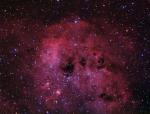 IC 410 and NGC 1893
15.08.2006
A faint, dusty rose of the northern sky, emission nebula IC 410 lies about 12,000 light-years away in the constellation Auriga. The cloud of glowing hydrogen gas is over 100 light-years across, sculpted by stellar winds and radiation from embedded open star cluster NGC 1893.
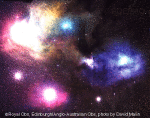 The Colorful Clouds of Rho Ophiuchi
12.03.1996
The many spectacular colors of the Rho Ophiuchi (oh'-fee-yu-kee) clouds highlight the many processes that occur there. The blue regions shine primarily by reflected light. Blue light from the star rho Ophiuchi and nearby stars reflects more efficiently off this portion of the nebula than red light.
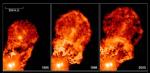 XZ Tauri System Ejects Gas Bubble
21.09.2000
Why is the binary star system XZ Tauri emitting a hot bubble of expanding gas? Although astronomers can only presently speculate, the Hubble Space Telescope clearly documents this unusual behavior in three dramatic photographs over the past five years.
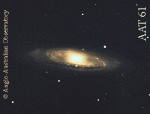 Leo Triplet Spiral Galaxy M65
12.08.1996
Spiral galaxy M65 is a normal spiral galaxy not unlike our own Milky Way. In fact, M65 is a typical spiral galaxy of a type that could be found anywhere in the local universe. Given a morphological type of "Sa", M65 shows tightly wrapped spiral arms and a large nuclear central bulge.
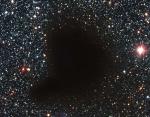 Molecular Cloud Barnard 68
2.02.2003
Where did all the stars go? What used to be considered a hole in the sky is now known to astronomers as a dark molecular cloud. Here, a high concentration of dust and molecular gas absorb practically all the visible light emitted from background stars.
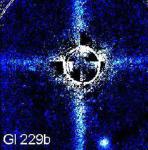 Brown Dwarf Gliese 229B
24.03.1999
The spot near the bottom is an image of an unusual type of object: a brown dwarf. A brown dwarf is sometimes called a "failed star" because it does not have enough mass to shine by nuclear fusion.
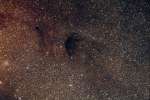 Dim World, Dark Nebula
8.07.2010
Dim, distant, dwarf planet Pluto can be hard to spot, especially in recent months as it wanders through the crowded starfields of Sagittarius and the central Milky Way. But fortunately for backyard Pluto hunters, it crossed in front of a dark nebula in early July.
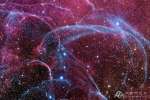 Filaments of the Vela Supernova Remnant
1.10.2013
The explosion is over but the consequences continue. About eleven thousand years ago a star in the constellation of Vela could be seen to explode, creating a strange point of light briefly visible to humans living near the beginning of recorded history.
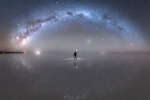 Night Sky Reflections from the Worlds Largest Mirror
22.10.2019
What's being reflected in the world's largest mirror? Stars, galaxies, and a planet. Many of these stars are confined to the grand arch that runs across the image, an arch that is the central plane of our home Milky Way Galaxy. Inside the arch is another galaxy -- the neighboring Large Magellanic Cloud (LMC).
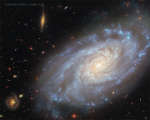 APOD: 2025 November 5 Б Spiral Galaxy NGC 3370 from Hubble
5.11.2025
Is this what our own Milky Way Galaxy looks like from far away? Similar in size and grand design to our home Galaxy (although without the central bar), spiral galaxy NGC 3370 lies about 100 million light-years away toward the constellation of the Lion (Leo).
|
January February March April May June July August September October |
|||||||||||||||||||||||||||||||||||||||||||||||||