
|
You entered: stars
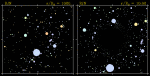 Too Close to a Black Hole
8.09.2002
What would you see if you went right up to a black hole? Above are two computer generated images highlighting how strange things would look. On the left is a normal star field containing the constellation Orion. Notice the three stars of nearly equal brightness that make up Orion's Belt.
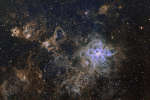 The Cosmic Web of the Tarantula Nebula
11.01.2011
It is the largest and most complex star forming region in the entire galactic neighborhood. Located in the Large Magellanic Cloud, a small satellite galaxy orbiting our Milky Way galaxy, the region's spidery appearance is responsible for its popular name, the Tarantula nebula. This tarantula, however, is about 1,000 light-years across.
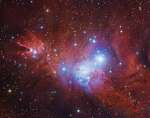 In the Vicinity of the Cone Nebula
6.08.2013
Strange shapes and textures can be found in neighborhood of the Cone Nebula. The unusual shapes originate from fine interstellar dust reacting in complex ways with the energetic light and hot gas being expelled by the young stars.
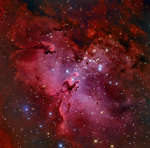 M16 and the Eagle Nebula
7.06.2014
A star cluster around 2 million years young, M16 is surrounded by natal clouds of dust and glowing gas also known as The Eagle Nebula. This beautifully detailed image of the region includes cosmic sculptures made famous in Hubble Space Telescope close-ups of the starforming complex.
 APOD: 2024 February 7 Б The Heart Shaped Antennae Galaxies
7.02.2024
Are these two galaxies really attracted to each other? Yes, gravitationally, and the result appears as an enormous iconic heart -- at least for now. Pictured is the pair of galaxies cataloged as NGC 4038 and NGC 4039,known as the Antennae Galaxies.
 BZ Cam Bow Shock
28.11.2000
BZ Cam is a binary star system that is not well understood. In most cataclysmic variables, matter from a normal star accumulates on the surface of the companion white dwarf star, eventually causing a nova-like flare as the material becomes hot enough to ignite nuclear fusion.
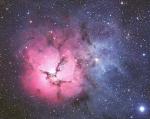 The Trifid Nebula from AAO
24.04.2002
Unspeakable beauty and unimaginable bedlam can be found together in the Trifid Nebula. Also known as M20, this photogenic nebula is visible with good binoculars towards the constellation of Sagittarius. The energetic processes of star formation create not only the colors but the chaos. The red-glowing gas results from high-energy starlight striking interstellar hydrogen gas.
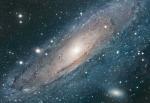 M31: The Andromeda Galaxy
21.10.2002
Andromeda is the nearest major galaxy to our own Milky Way Galaxy. Our Galaxy is thought to look much like Andromeda. Together these two galaxies dominate the Local Group of galaxies. The diffuse light from Andromeda is caused by the hundreds of billions of stars that compose it.
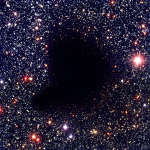 APOD: 2023 January 29 Б Barnard 68: Dark Molecular Cloud
29.01.2023
Where did all the stars go? What used to be considered a hole in the sky is now known to astronomers as a dark molecular cloud. Here, a high concentration of dust and molecular gas absorb practically all the visible light emitted from background stars.
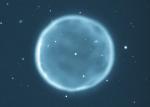 Spherical Planetary Nebula Abell 39
23.01.2001
One of the largest spheres in our Galaxy is giving valuable clues about the chemical composition of stars by its very shape. Planetary nebula Abell 39, now six light-years across, was once a sun-like star's outer atmosphere expelled thousands of years ago.
|
January February March April May June July August September October |
|||||||||||||||||||||||||||||||||||||||||||||||||