
|
You entered: Sun
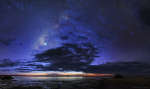 Night Hides the World
7.02.2014
Stars come out as evening twilight fades in this serene skyscape following the Persian proverb "Night hides the world, but reveals a universe." In the scene from last November, the Sun is setting over northern Kenya and the night will soon hide the shores of Lake Turkana, home to many Nile crocodiles.
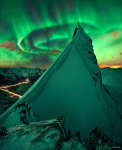 In Green Company: Aurora over Norway
2.11.2014
Raise your arms if you see an aurora. With those instructions, two nights went by with, well, clouds -- mostly. On the third night of returning to same peaks, though, the sky not only cleared up but lit up with a spectacular auroral display.
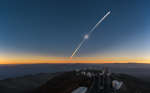 La Silla Eclipse Sequence
5.07.2019
The road to the high mountaintop La Silla Observatory in the Chilean Atacama Desert also led in to the path of July 2nd's total solar eclipse. Recorded at regular intervals before and after...
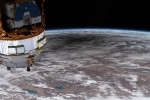 Eclipse under the ISS
27.06.2020
The dark shadow of the New Moon reached out and touched planet Earth on June 21. A high definition camera outside the International Space Station captured its passing in this snapshot from low Earth orbit near the border of Kazakhstan and China.
 Good Morning Moon
12.01.2024
Yesterday, the Moon was New. But on January 9, early morning risers around planet Earth were treated to the sight of an old Moon, low in the east as the sky grew bright before dawn.
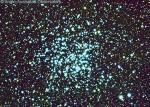 Wild Duck Open Cluster M11
22.10.2000
Many stars like our Sun were formed in open clusters. The above open cluster, M11, contains thousands of stars and is just over three thousand light years distant. The stars in this cluster all formed together about 150 million years ago. The bright young stars in M11 appear blue.
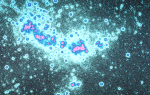 LMC Star Clouds
11.10.1995
Pictured above are clouds of young stars forming an arc in the nearby Large Magellanic Cloud, the nearest galaxy to the our Milky Way Galaxy. These stars are situated in a star forming region known as N 51.
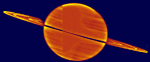 Sunlight Through Saturn's Rings
11.05.1996
Normally, Earth based astronomers view Saturn's spectacular ring system fully illuminated by reflected sunlight. However, this November 1995 Hubble Space Telescope composite image was made to take advantage of an unusual perspective, with the Sun actually illuminating the rings from below.
 Sentinels of the Arctic
29.05.2012
Who guards the north? Judging from the above photograph, possibly giant trees covered in snow and ice. The picture was taken last winter in Finnish Lapland where weather can include sub-freezing temperatures and driving snow. Surreal landscapes sometimes result, where common trees become cloaked in white and so appear, to some, as watchful aliens.
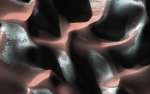 Martian Chiaroscuro
22.03.2014
Deep shadows create dramatic contrasts between light and dark in this high-resolution close-up of the martian surface. Recorded on January 24 by the HiRISE camera onboard the Mars Reconnaissance Orbiter, the scene spans about 1.5 kilometers across a sand dune field in a southern highlands crater.
|
January February March April May June |
|||||||||||||||||||||||||||||||||||||||||||||||||