
|
You entered: space
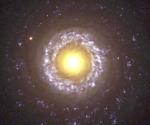 Seyfert Galaxy NGC 7742
23.10.1998
This might resemble a fried egg you've had for breakfast, but it's actually much larger. In fact, ringed by blue-tinted star forming regions and faintly visible spiral arms, the yolk-yellow center of this face-on spiral galaxy, NGC 7742, is about 3,000 light-years across.
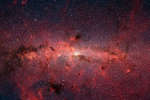 Stars at the Galactic Center
14.06.2009
The center of our Milky Way Galaxy is hidden from the prying eyes of optical telescopes by clouds of obscuring dust and gas. But in this stunning vista, the Spitzer Space Telescope's infrared cameras, penetrate much of the dust revealing the stars of the crowded galactic center region.
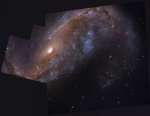 NGC 2442: Galaxy in Volans
25.03.2010
Distorted galaxy NGC 2442 can be found in the southern constellation of the flying fish, (Piscis) Volans. Located about 50 million light-years away, the galaxy's two spiral arms extending from a pronounced central bar have a hook-like appearance in wide-field images.
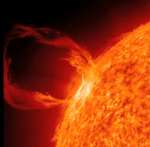 Large Eruptive Prominence Imaged by SDO
10.05.2010
Sometimes part of the Sun can just explode into space. These explosions might occur as powerful solar flares, coronal mass ejections, or comparatively tame eruptive solar prominences. Pictured above is one of the largest solar prominence eruptions yet observed, one associated with a subsequent coronal mass ejection.
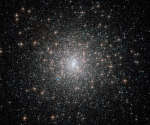 Globular Cluster M15 from Hubble
3.05.2011
Stars, like bees, swarm around the center of bright globular cluster M15. This ball of over 100,000 stars is a relic from the early years of our Galaxy, and continues to orbit the Milky Way's center.
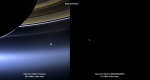 Two Views of Earth
23.07.2013
In a cross-Solar System interplanetary first, our Earth was photographed during the same day from both Mercury and Saturn. Pictured on the left, Earth is the pale blue dot just below the rings of Saturn, as captured by the robotic Cassini spacecraft now the gas giant.
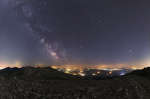 Summer Planets and Milky Way
23.07.2016
Lights sprawl toward the horizon in this night skyscape from Uludag National Park, Bursa Province, Turkey, planet Earth. The stars and nebulae of the Milky Way are still visible though, stretching above the lights on the northern summer night while three other planets shine brightly.
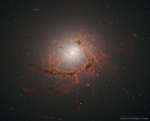 NGC 4696: Filaments around a Black Hole
7.12.2016
What's happening at the center of elliptical galaxy NGC 4696? There, long tendrils of gas and dust have been imaged in great detail as shown by this recently released image from the Hubble Space Telescope.
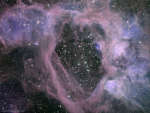 The N44 Superbubble
25.06.2017
What created this gigantic hole? The vast emission nebula N44 in our neighboring galaxy the Large Magellanic Cloud has a large, 250 light-year hole and astronomers are trying to figure out why. One possibility is particle winds expelled by massive stars in the bubble's interior that are pushing out the glowing gas.
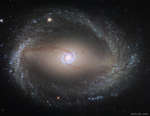 Spiral Galaxy NGC 1512: The Inner Ring
7.08.2017
Most galaxies don't have any rings -- why does this galaxy have two? To begin, the bright band near NGC 1512's center is a nuclear ring, a ring that surrounds the galaxy center and glows brightly with recently formed stars.
|
January February March April May June July August September |
|||||||||||||||||||||||||||||||||||||||||||||||||