
|
You entered: space
 A Great Day For SOHO
15.10.1998
The last 10 days have been great days for SOHO, the space-based SOlar and Heliospheric Observatory. Contact was completely lost with this international research spacecraft over 3 months ago but recovery teams have reacquired control of SOHO and, beginning October 5th, have been successfully switching on its scientific instruments.
 HUDF: Dawn of the Galaxies
29.09.2004
When did galaxies form? Faint red smudges identified on the deepest optical sky image ever taken may well be members of the first class of galaxies. Detailed inspection of the Hubble Ultra Deep Field...
 Old Planetary Dust Disks Found by SST
19.10.2004
Why are some older stars surrounded by dust? Observations from the Spitzer Space Telescope by a team led by George Rieke (U. Arizona) were expected to show that young stars, on the order of one million years old, have large dust disks, while relatively older stars, between 10 and 100 million years old, have none.
 A Map of Asteroid Vesta
20.08.2006
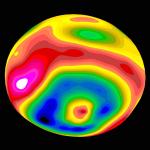
Vesta is a huge rock 500 kilometers across that orbits out past Mars. In 1997, the above map of Vesta created using the Hubble Space Telescope was released showing a rugged surface highlighted by a single crater spanning nearly the entire length of the asteroid.
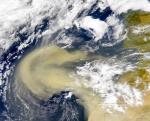 Dust Storm on Planet Earth
3.03.2000
From low Earth orbit, NASA's SeaWIFS instrument records ocean color, tracking changes in our water world's climate and biosphere. But even an ocean planet can have dust storms. On February 26th, SeaWIFS...
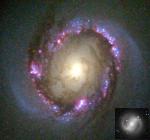 NGC 4314: A Nuclear Starburst Ring
12.12.1999
Is this old galaxy up to new tricks? The barred spiral galaxy NGC 4314 is billions of years old, but its appearance has changed markedly over just the past few millions of years. During that time, a nuclear ring of bright young stars has been evolving.
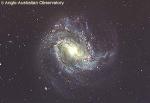 M83: A Barred Spiral Galaxy
26.09.1999
M83 is a bright spiral galaxy that can be found with a small telescope in the constellation of Hydra. It takes light about 15 million years to reach us from M83. M83 is quite a typical spiral - much like our own Milky Way Galaxy.
 Galaxy Evolution Tracking Animation
30.05.2016
How did the universe evolve from such a smooth beginning? To help understand, computational cosmologists and NASA produced the featured time-lapse animated video depicting a computer simulation of part of the universe. The 100-million light-year simulation starts about 20 million years after the Big Bang and runs until the present.
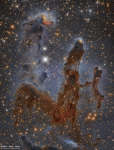 Pillars of the Eagle Nebula in Infrared
20.06.2018
Newborn stars are forming in the Eagle Nebula. Gravitationally contracting in pillars of dense gas and dust, the intense radiation of these newly-formed bright stars is causing surrounding material to boil away. This image...
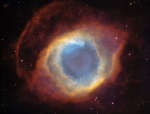 The Helix Nebula from Blanco and Hubble
23.08.2020
How did a star create the Helix nebula? The shapes of planetary nebula like the Helix are important because they likely hold clues to how stars like the Sun end their lives. Observations...
|
January February March April May June July August September |
|||||||||||||||||||||||||||||||||||||||||||||||||