
|
You entered: space
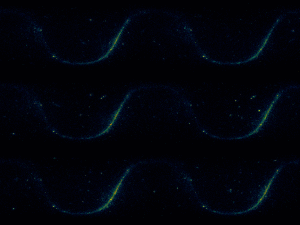 Simulated Gamma ray Sky
31.05.2006
Scheduled for launch in 2007, the Gamma-ray Large Area Space Telescope (GLAST) will explore the Universe in gamma-rays, the most energetic form of light. To get ready, consider this dynamic gamma-ray sky animation - constructed from simulating the first 55 days (seen above at one frame per day) of GLAST observations of cosmic gamma-ray sources.
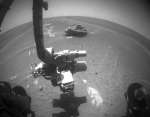 Block Island Meteorite on Mars
13.08.2009
What is this strange rock on Mars? Sitting on a smooth plane, the rock stands out for its isolation, odd shape, large size and unusual texture. The rock was discovered by the robotic Opportunity rover rolling across Mars late last month. Pictured above, Opportunity prepares to inspect the unusual rock.
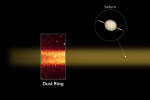 Giant Dust Ring Discovered Around Saturn
13.10.2009
What has created a large dust ring around Saturn? At over 200 times the radius of Saturn and over 50 times the radius of Saturn's expansive E ring, the newly discovered dust ring is the largest planetary ring yet imaged. The ring was found in infrared light by the Earth-orbiting Spitzer Space Telescope.
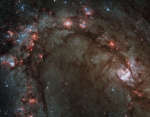 M83s Center from Refurbished Hubble
15.11.2009
What's happening at the center of spiral galaxy M83? Just about everything, from the looks of it. M83 is one of the closest spiral galaxies to our own Milky Way Galaxy and from a distance of 15 million light-years, appears to be relatively normal.
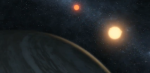 Kepler 16b: A Planet with Two Suns
20.09.2011
If you stay up long enough, you can watch both suns set. Such might be a common adage from beings floating in the atmosphere of Kepler 16b, a planet recently discovered by the space-based Kepler satellite. The above animated video shows how the planetary system might look to a visiting spaceship.
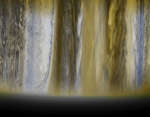 Jupiter's Clouds from New Horizons
23.10.2011
The New Horizons spacecraft took some stunning images of Jupiter on its way out to Pluto. Famous for its Great Red Spot, Jupiter is also known for its regular, equatorial cloud bands, visible through even modest sized telescopes.
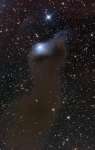 VdB 152: A Ghost in Cepheus
31.10.2012
Described as a "dusty curtain" or "ghostly apparition", mysterious reflection nebula VdB 152 really is very faint. Far from your neighborhood on this Halloween Night, the cosmic phantom is nearly 1,400 light-years away. Also catalogued as Ced 201, it lies along the northern Milky Way in the royal constellation Cepheus.
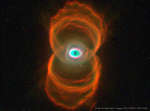 MyCn18: An Hourglass Planetary Nebula
9.05.2015
The sands of time are running out for the central star of this hourglass-shaped planetary nebula. With its nuclear fuel exhausted, this brief, spectacular, closing phase of a Sun-like star's life occurs as its outer layers are ejected - its core becoming a cooling, fading white dwarf.
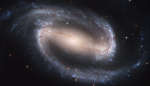 Barred Spiral Galaxy NGC 1300
8.01.2016
Big, beautiful, barred spiral galaxy NGC 1300 lies some 70 million light-years away on the banks of the constellation Eridanus. This Hubble Space Telescope composite view of the gorgeous island universe is one of the largest Hubble images ever made of a complete galaxy.
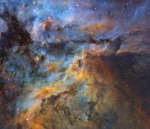 South of Carina
21.05.2020
With natal dust clouds in silhouette against glowing atomic gas, this colorful and chaotic vista lies within one of the largest star forming regions in the Milky Way galaxy, the Great Carina Nebula.
|
January February March April May June July August September |
|||||||||||||||||||||||||||||||||||||||||||||||||