
|
You entered: sky
 Nightlights in Qeqertaq
17.11.2023
Light pollution is usually not a problem in Qeqertaq. In western Greenland the remote coastal village boasted a population of 114 in 2020. Lights still shine in its dark skies though. During planet Earth's recent intense geomagnetic storm, on November 6 these beautiful curtains of aurora borealis fell over the arctic realm.
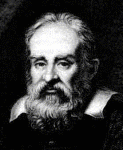 Galileo Demonstrates the Telescope
13.09.1998
Galileo Galilei made a good discovery great. Upon hearing at age 40 that a Dutch optician had invented a glass that made distant objects appear larger, Galileo crafted his own telescope and turned it toward the sky.
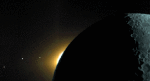 The Ecliptic Plane
27.09.1997
The Plane of the Ecliptic is illustrated in this Clementine star tracker camera image which reveals (from right to left) the Moon lit by Earthshine, the Sun's corona rising over the Moon's dark limb, and the planets Saturn, Mars, and Mercury.
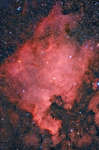 The North America Nebula
28.10.2008
The North America Nebula in the sky can do what most North Americans on Earth cannot -- form stars. Specifically, in analogy to the Earth-confined continent, the bright part that appears as Central America and Mexico is actually a hot bed of gas, dust, and newly formed stars known as the Cygnus Wall.
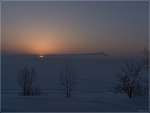 Sunset, Moonset
7.01.2011
Seen from central and northern Asia, the Sun and New Moon set together on January 4, in a partial solar eclipse. Close to its maximum phase, the eclipse is captured near the moment of sunset in this wintry scene from the bank of the Berd River near Novosibirsk, Siberia, Russia.
 Gamma Ray Crab, Geminga
24.06.1995
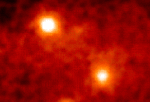
What if you could "see" in gamma-rays? If you could, these two spinning neutron stars or pulsars would be among the brightest objects in the sky. This computer processed image shows the Crab Nebula pulsar (below and right of center) and the Geminga pulsar (above and left of center) in the "light" of gamma-rays.
 Galileo Demonstrates the Telescope
30.08.1996
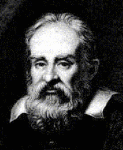
Galileo Galilei made a good discovery great. Upon hearing at age 40 that a Dutch optician had invented a glass that made distant objects appear larger, Galileo crafted his own telescope and turned it toward the sky.
 A Halo Around the Moon
21.04.2003
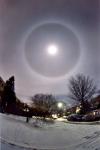
Have you ever seen a halo around the Moon? This fairly common sight occurs when high thin clouds containing millions of tiny ice crystals cover much of the sky. Each ice crystal acts like a miniature lens.
 Comet SOHO and Nebulae in Orion
4.06.1998
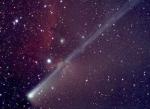
Astrophotographer Michael Horn captured this gorgeous view of comet SOHO in the dark night sky above Wandibindle, Queensland, Australia on May 23rd. On this date, comet SOHO was moving against the background of the nebula-rich constellation of Orion.
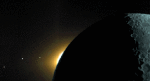 The Ecliptic Plane
29.05.1999
The Plane of the Ecliptic is illustrated in this Clementine star tracker camera image which reveals (from right to left) the Moon lit by Earthshine, the Sun's corona rising over the Moon's dark limb, and the planets Saturn, Mars, and Mercury.
|
January February March April May June July August September October |
|||||||||||||||||||||||||||||||||||||||||||||||||