
|
You entered: sky
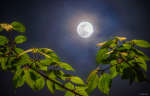 Full Moon of Spring
10.04.2020
From home this Full Moon looked bright. Around our fair planet it rose as the Sun set on April 7/8, the first Full Moon after the vernal equinox and the start of northern hemisphere spring. April's full lunar phase was also near perigee, the closest point in the Moon's elliptical orbit.
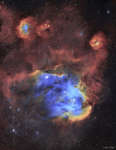 IC 2944: The Running Chicken Nebula
20.04.2020
To some, it looks like a giant chicken running across the sky. To others, it looks like a gaseous nebula where star formation takes place. Cataloged as IC 2944, the Running Chicken Nebula spans about 100 light years and lies about 6,000 light years away toward the constellation of the Centaur (Centaurus).
 Northern Summer Twilight
19.06.2021
Nights grow shorter and days grow longer as the summer solstice approaches in the north. Usually seen at high latitudes in summer months, noctilucent or night shining clouds begin to make their appearance. Drifting...
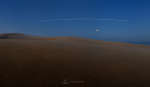 A View from Earth s Shadow
20.05.2022
This serene sand and skyscape finds the Dune of Pilat on the coast of France still in Earth's shadow during the early morning hours of May 16. Extending into space, the planet's dark umbral shadow covered the Moon on that date.
 Fireworks vs Supermoon
6.07.2023
On July 4, an almost Full Moon rose in planet Earth's evening skies. Also known as a Buck Moon, the full lunar phase (full on July 3 at 11:39 UTC) was near perigee, the closest point in the Moon's almost monthly orbit around planet Earth.
 APOD: 2025 June 16 Б APOD is 30 Years Old Today
16.06.2025
APOD is 30 years old today. In celebration, today's picture uses past APODs as tiles arranged to create a single pixelated image that might remind you of one of the most well-known and evocative depictions of planet Earth's night sky.
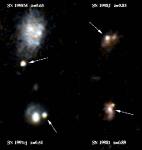 The Year of Distant Supernovae
31.12.1998
Distant supernovae were among topics at the forefront of astronomy during 1998. Two independent groups raced to deploy large telescopes to scan the sky, discovering and analyzing far-off supernovae with the promise of calibrating the geometry of our universe.
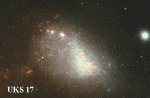 The Small Cloud of Magellan
19.07.1997
The southern sky contains wonders almost unknown in the north. These wonders include the Large and Small Magellanic Clouds: small irregular galaxies orbiting our own larger Milky Way spiral galaxy. The Small Magellanic Cloud (SMC), pictured here, is about 250,000 light years away.
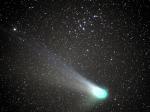 Comet NEAT and the Beehive Cluster
17.06.2004
To the unaided eye, they appeared as similar fuzzy patches. But when a bright comet passed in front of a bright star cluster last month, binoculars and cameras were able to show off their marked differences in dramatic fashion.
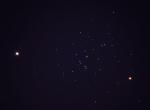 Saturn, Mars, and the Beehive Cluster
17.06.2006
Grab a pair of binoculars and check out Saturn and Mars in the early evening sky tonight! Looking west shortly after sunset, your view could be similar to this one - recorded on June 14.
|
January February March April May June July August September October |
|||||||||||||||||||||||||||||||||||||||||||||||||