
|
You entered: sky
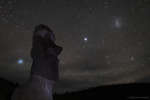 Stars Over Easter Island
12.10.2009
Why were the statues on Easter Island built? No one is sure. What is sure is that over 800 large stone statues exist there. The Easter Island statues, stand, on the average, over twice as tall as a person and have over 200 times as much mass.
 Sentinels of the Arctic
29.05.2012
Who guards the north? Judging from the above photograph, possibly giant trees covered in snow and ice. The picture was taken last winter in Finnish Lapland where weather can include sub-freezing temperatures and driving snow. Surreal landscapes sometimes result, where common trees become cloaked in white and so appear, to some, as watchful aliens.
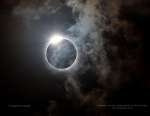 Diamond Ring and Shadow Bands
21.11.2012
As the total phase of last week's solar eclipse came to an end, sunlight streaming past the edge of the Moon created the fleeting appearance of a glistening diamond ring in the sky.
 A Five Planet Dawn
30.01.2016
As January closes and in the coming days of February, early morning risers can spot the five naked-eye planets before dawn. Though some might claim to see six planets, in this seaside panoramic view all five celestial wanderers were found above the horizon along with a bright waning gibbous Moon on January 27.
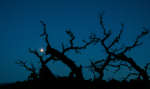 Blood Monster Moon
4.06.2021
On May 26, the Full Flower Moon was caught in this single exposure as it emerged from Earth's shadow and morning twilight began to wash over the western sky. Posing close...
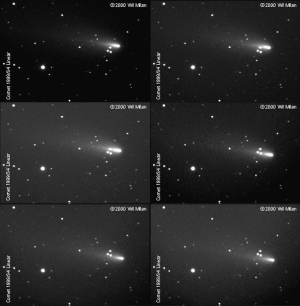 Comet LINEAR Approaches
4.07.2000
Just possibly, a new comet may become bright enough to see without binoculars later this month. Comet C/1999 S4 LINEAR is rapidly approaching both the Earth and the Sun from the outer Solar System, and should be at its brightest around 2000 July 25 in the early evening sky of northern observers.
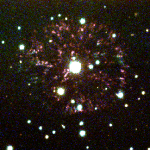 The Firework Nebula
4.07.1995
The Firework Nebula, known to astronomers as "GK Per", is the result of a type of stellar explosion called a nova. In a nova, a very compact star called a white dwarf blasts away gas that had accumulated on its surface.
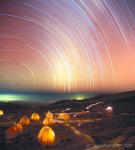 The Star Trails of Kilimanjaro
7.03.2003
The night had no moon, but the stars were out. And camped at 16,000 feet on Mt. Kilimanjaro, photographer Dan Heller recorded this marvelous 3 1/2 hour long exposure. Here the landscape is lit mostly by the stars.
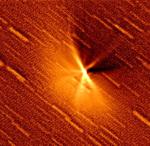 More Jets from Comet Hale-Bopp
13.02.1997
Comets become fountains of gas and dust as they get near the Sun. Solar heat vaporizes the outer layers of these spectacular orbiting icebergs, exposing caverns of pressurized gas that erupt into jets. The above digitally enhanced image of Comet Hale-Bopp was taken on January 29th and highlights several of these dust jets.
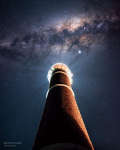 Milky Way over Uruguayan Lighthouse
19.11.2019
Can a lighthouse illuminate a galaxy? No, but in the featured image, gaps in light emanating from the Jose Ignacio Lighthouse in Uruguay appear to match up nicely, although only momentarily and coincidently, with dark dust lanes of our Milky Way Galaxy. The bright dot on the right is the planet Jupiter.
|
January February March April May June July August September October |
|||||||||||||||||||||||||||||||||||||||||||||||||