
|
You entered: sky
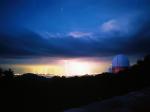 Lightning on Earth
18.08.2004
Nobody knows what causes lightning. It is known that charges slowly separate in some clouds causing rapid electrical discharges (lightning), but how electrical charges get separated in clouds remains a topic of much research.
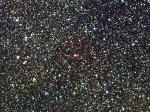 Proxima Centauri: The Closest Star
4.12.2005
What is the closest star to our Sun? It is Proxima Centauri, the nearest member of the Alpha Centauri triple star system. Light takes only 4.22 years to reach us from Proxima Centauri. This...
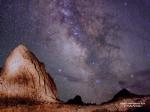 The Milky Way over Utah
1.08.2006
If sometimes it appears that the entire Milky Way Galaxy is raining down on your head, do not despair. It happens twice a day. As the Sun rises in the East, wonders of the night sky become less bright than the sunlight scattered by our own Earth's atmosphere, and so fade from view.
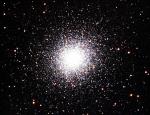 M13: The Great Globular Cluster in Hercules
1.03.2000
M13 is one of the most prominent and best known globular clusters. Visible with binoculars in the constellation of Hercules, M13 is frequently one of the first objects found by curious sky gazers seeking celestials wonders beyond normal human vision.
 A Milky Way Band
10.07.2011
Most bright stars in our Milky Way Galaxy reside in a disk. Since our Sun also resides in this disk, these stars appear to us as a diffuse band that circles the sky.
 Cirrus over Paris
22.06.2016
What's that over Paris? Cirrus. Typically, cirrus clouds appear white or gray when reflecting sunlight, can appear dark at sunset (or sunrise) against a better lit sky. Cirrus are among the highest types of clouds and are usually thin enough to see stars through.
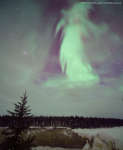 Ghost Aurora over Canada
27.10.2019
What does this aurora look like to you? While braving the cold to watch the skies above northern Canada early one morning in 2013, a most unusual aurora appeared. The aurora definitely appeared to be shaped like something , but what?
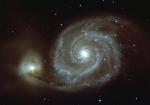 M51: The Whirlpool Galaxy
24.07.2000
The Whirlpool Galaxy is a classic spiral galaxy. At only 23 million light years distant and fully 65 thousand light years across, M51, also known as NGC 5194, is one of the brightest and most picturesque galaxies on the sky.
 The Small Cloud of Magellan
19.09.1995
Almost unknown to casual observers in the northern hemisphere, the southern sky contains two diffuse wonders known as the Magellanic Clouds. The Magellanic Clouds are small irregular galaxies orbiting our own larger Milky Way spiral galaxy.
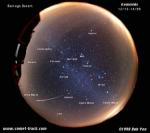 A Geminid from Gemini
29.12.1998
The Leonid meteor shower was not the only good meteor shower this season. Earlier this month, the annual Geminids meteor shower peaked, featuring as many as 140 meteors per hour from some locations. Geminid meteors can be seen streaking away from the constellation of Gemini, as depicted in the above all-sky photograph.
|
January February March April May June July August September October |
|||||||||||||||||||||||||||||||||||||||||||||||||