
|
You entered: image
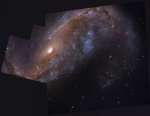 NGC 2442: Galaxy in Volans
25.03.2010
Distorted galaxy NGC 2442 can be found in the southern constellation of the flying fish, (Piscis) Volans. Located about 50 million light-years away, the galaxy's two spiral arms extending from a pronounced central bar have a hook-like appearance in wide-field images.
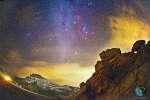 Deep Orion Over the Canary Islands
23.01.2012
Which attracts your eye more -- the sky or the ground? On the ground are rocky peaks in Teide National Park on Tenerife Island of the Spanish Canary Islands off the northwestern coast of Africa. The volcanic landscape features old island summits and is sometimes used as a testbed for instruments on future Martian rovers.
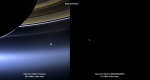 Two Views of Earth
23.07.2013
In a cross-Solar System interplanetary first, our Earth was photographed during the same day from both Mercury and Saturn. Pictured on the left, Earth is the pale blue dot just below the rings of Saturn, as captured by the robotic Cassini spacecraft now the gas giant.
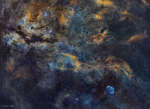 Central Cygnus Skyscape
19.08.2015
In cosmic brush strokes of glowing hydrogen gas, this beautiful skyscape unfolds across the plane of our Milky Way Galaxy and the center of the northern constellation Cygnus the Swan. The featured image spans about six degrees.
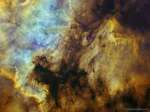 The North America and Pelican Nebulas
14.06.2016
Here lie familiar shapes in unfamiliar locations. On the left is an emission nebula cataloged as NGC 7000, famous partly because it resembles our fair planet's continent of North America. The emission region to the right of the North America Nebula is IC 5070, also known for its suggestive outlines as the Pelican Nebula.
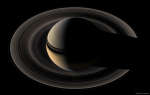 Crescent Saturn
8.08.2020
From Earth, Saturn never shows a crescent phase. But when viewed from a spacecraft the majestic giant planet can show just a sunlit slice. This image of crescent Saturn in natural color was taken by the robotic Cassini spacecraft in 2007.
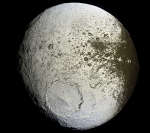 Saturns Iapetus: Painted Moon
9.08.2009
What has happened to Saturn's moon Iapetus? Vast sections of this strange world are dark as coal, while others are as bright as ice. The composition of the dark material is unknown, but infrared spectra indicate that it possibly contains some dark form of carbon.
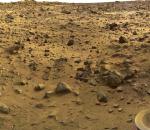 25 Years Ago: Vikings on Mars
21.07.2001
On July 20, 1976, NASA's Viking 1 lander become the first spacecraft to land on Mars, followed weeks later by its twin robot explorer, the Viking 2 lander. Operating on the Martian surface...
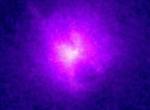 Hot Gas In Hydra A
17.12.1999
The Hydra A galaxy cluster is really big. In fact, such clusters of galaxies are the largest gravitationally bound objects in the Universe. But individual galaxies are too cool to be recorded in this false-color Chandra Observatory X-ray image which shows only the 40 million degree gas that permeates the Hydra A cluster.
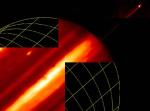 Jupiter: Moon, Ring, and Clouds
21.11.1997
An inner moon, an edge-on, planet-girdling ring, and high altitude cloud bands are visible in this mosaic of infrared images of gas giant Jupiter. The moon Metis, 25 miles wide and about 80,000 miles from the planet, is the bright spot at the upper right.
|
January February March April May June July August September |
|||||||||||||||||||||||||||||||||||||||||||||||||