
|
You entered: image
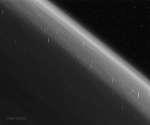 Tau Herculids from Space
3.06.2022
On May 31 tens of parallel meteor streaks were recorded in this 8 degree wide field of view of planet Earth's limb from space. The image is one of a series of 5 minute long observations by the orbiting Yangwang-1 space telescope.
 APOD: 2024 September 2 Б A Triangular Prominence Hovers Over the Sun
1.09.2024
Why is there a triangle hovering over the Sun? Although the shape is unusual, the type of structure is not: it is part of an evolving solar prominence. Looping magnetic fields on the Sun channel the flow of energetic particles, sometimes holding glowing gaseous structures aloft for months.
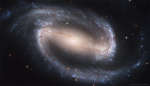 APOD: 2026 May 17 Б NGC 1300: Barred Spiral Galaxy
16.05.2026
Across the center of this spiral galaxy is a bar. And at the center of this bar is smaller spiral. And at the center of that spiral is a supermassive black hole. This...
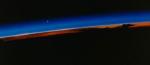 Venus On The Horizon
14.10.1997
The month of October features a sky full of planets, including Venus as the brilliant evening star. Besides the sun and moon, Venus is the brightest object visible in Earth's sky. This month, Venus appears in early evening near the red planet Mars and Mars' red giant rival Antares above the southwestern horizon.
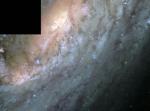 Barred Spiral Galaxy NGC 2903
20.03.2001
NGC 2903 is a spiral galaxy similar to our own Milky Way Galaxy. Similarities include its general size and a central bar. One striking difference, however, is the appearance of mysterious hot spots in NGC 2903's core. Upon
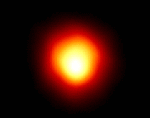 Betelgeuse, Betelgeuse, Betelgeuse
21.01.1996
Betelgeuse (sounds a lot like "beetle juice"), a red supergiant star about 600 lightyears distant, is shown here in this Hubble Space Telescope image which represents the first direct picture of the surface of a star other than the Sun.
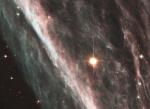 APOD: 2003 June 9 Ш The Pencil Nebula Supernova Shockwave
9.06.2003
At 500,000 kilometers per hour, a supernova shockwave plows through interstellar space. This shockwave is known as the Pencil Nebula, or NGC 2736, and is part of the Vela supernova remnant, an expanding shell of a star that exploded about 11,000 years ago.
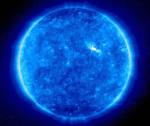 Blue Sun Glaring
5.01.1997
The Sun is a bubbling ball of extremely hot gas. In this false-color picture, light blue regions are extremely hot - over 1 million degrees, while dark blue regions are slightly cooler. The camera filter used was highly sensitive to the emission of highly charged iron ions, which trace the magnetic field of the Sun.
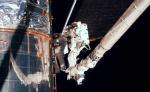 New Eyes for the Hubble Space Telescope
20.02.1997
The Hubble Space Telescope's second servicing mission has been completed. Every few years, the telescope is visited by a Space Shuttle to allow astronauts to switch old instruments for new. This time...
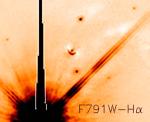 Diffraction Spikes: When Stars Look Like Crosses
18.11.1997
Unusual appendages around bright stars are commonplace, but never seem to be mentioned. What are they? First, a telescope brings starlight falling over a large area to a small area. To get at this...
|
January February March April May June July August September |
|||||||||||||||||||||||||||||||||||||||||||||||||