
|
You entered: image
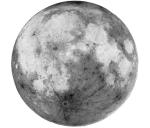 Full Moondark
12.12.2003
The brilliant full Moon might not have looked quite like this to skygazers this week, but the image is a mosaic of 18 digital frames recorded on December 9th at 3:30 UT.
 Steep Cliffs on Mars
15.03.2005
Vertical cliffs of nearly two kilometers occur near the North Pole of Mars. Also visible in the above image of the Martian North Polar Cap are red areas of rock and sand, white areas of ice, and dark areas of unknown composition but hypothesized to be volcanic ash.
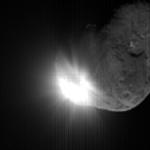 Thirteen Seconds After Impact
5.07.2005
Fireworks came early on July 4th when, at 1:52am EDT, the Deep Impact spacecraft's probe smashed into the surface of Comet Tempel 1's nucleus at ten kilometers per second. The well-targeted impactor probe was vaporized as it blasted out an expanding cloud of material, seen here 13 seconds after the collision.
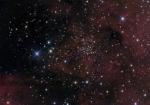 Tombaugh 4
21.10.2006
Clyde Tombaugh discovered planet Pluto in 1930 while surveying the skies with the 13-inch Lawrence Lowell Telescope. But the skilled and careful astronomer also went on to discover star clusters, comets, asteroids, and clusters of galaxies. For example, pictured is galactic or open star cluster Tombaugh 4 in the northern constellation Cassiopeia.
 Simulated Transit of Mercury
8.11.2006
Mercury, the solar system's innermost planet, will spend about five hours crossing in front of the Sun today - beginning at 1912 UT (2:12pm EST), November 8. Specially equipped telescopes are highly recommended...
 The Milky Road
13.06.2009
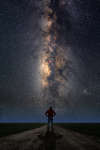
Inspired by the night skies of planet Earth in the International Year of Astronomy, photographer Larry Landolfi created this tantalizing fantasy view. The composited image suggests a luminous Milky Way is the heavenly extension of a country road.
 Gigagalaxy Zoom: Milky Way
26.09.2009
Our magnificent Milky Way Galaxy sprawls across this ambitious all-sky panorama. In fact, at 800 million pixels the full resolution mosaic strives to show all the stars the eye can see in planet Earth's night sky.
 Tyrrhenian Sea and Solstice Sky
20.12.2014
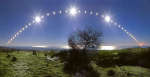
Today the solstice occurs at 23:03 Universal Time, the Sun reaching its southernmost declination in planet Earth's sky. Of course, the December solstice marks the beginning of winter in the northern hemisphere and summer in the south.
 Charon
17.07.2015
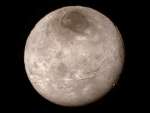
Icy world Charon is 1,200 kilometers across. That makes Pluto's largest moon only about 1/10th the size of planet Earth but a whopping 1/2 the diameter of Pluto itself. Charon is seen in unprecedented detail in this image from New Horizons.
 M31: The Andromeda Galaxy
17.12.2018
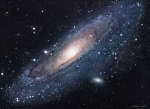
What is the nearest major galaxy to our own Milky Way Galaxy? Andromeda. In fact, our Galaxy is thought to look much like Andromeda. Together these two galaxies dominate the Local Group of galaxies. The diffuse light from Andromeda is caused by the hundreds of billions of stars that compose it.
|
January February March April May June July August September |
|||||||||||||||||||||||||||||||||||||||||||||||||